Showing posts with label tips. Show all posts

Thursday, May 31, 2018

Sanding Block Pro Tip


A while back, I showed a way to remove self-adhesive sandpaper from an aluminum sanding block, like the Great Planes Easy-Touch Hand Sander*, seen above.

Self-adhesive sandpaper, such as the stuff I buy from Klingspoor, has such a powerful adhesive on it that you can't simply peel it back off the aluminum.

My solution was to hold the sander under a stream of warm water and slowly but firmly peel the sandpaper off.


Any remaining adhesive is cleaned off with a cotton swab and an adhesive solvent such as lighter fluid.


While this certainly works, someone suggested to me a much easier, faster way, and it doesn't require running water.

All you need is cheap masking tape.

The Great Planes hand sander is just a hair over 2 inches wide. I got the cheapest masking tape I could find over 2 inches - a 3-inch wide roll for about $5. (That's a Boston hardware store price. In most parts of the U.S. you should be able to find it cheaper.)

Just adhere a strip of the tape directly to your sanding block.


Trim the tape down to the edges of the sander.


Now you can attach the self-adhesive sandpaper as you would normally, and trim that down as well.


Despite being a lot less sticky than the sandpaper itself, the masking tape will hold up to pretty heavy use. Once you're ready to change paper, you can just peel it off the sanding block with a fingernail.


Now you can quickly and cleanly change paper without any running water, and with no need to use a solvent to clean up any remaining adhesive residue.

You should use one piece of tape wide enough to cover the whole sander. If you try to put two narrower pieces side by side, the ridge will show through on the sandpaper side, and your sanding surface won't be perfectly flat.

Even if you don't own a Great Planes Hand Sander, the masking tape method should work with even a simple wood block sander. Whereas the sandpaper's adhesive would take the surface off a wood block, cheap masking tape should peel off easily. Having the sandpaper adhered flatly against the sanding surface is much better and flatter than simply wrapping a piece of sandpaper around a wooden block, as it gives you more control.

*As of this writing, it's difficult to find a Great Planes hand sander. Great Planes was owned by Hobbico, and as a result, was part of the whole Hobbico bankruptcy. We in model rocketry got really lucky that Estes was purchased by Estes Industries, LLC, run by people who actually really care about the hobby itself. Hobbico's other holdings have apparently been purchased by Hobbico rival Horizon, and so far, the future of all its holdings is uncertain. The Easy Touch Hand Sander has been on backorder for some time. I hope it returns to market some time soon. It's such a simple, elegant tool - my favorite in the tool box. I own three! I'll try to keep track of when the Great Planes sanders come back and post about it here. I recommend you get one. They're inexpensive and a great little tool.

Follow me on Twitter.

Like my Facebook page for blog updates and extra stuff.

Have a question you'd like to see addressed on this blog? Email me at iamtherocketn00b@gmail.com.

Friday, September 18, 2015

Igniter Tip - Q2G2's Keep Falling Out?

Edit:

If you look at the comment section below, you'll see a few rocketeers have corrected my big dumb mistake here. Turns out, I was mis-reading the instructions for the Q2G2 igniter, and inserting it all wrong in the first place.

My initial reaction was to delete this post. But I've decided to leave it up for two reasons.

1 - It's a good example of a n00b mistake - not reading the directions.

2 - It's full of pretty pictures.

For the correct method of installing Q2G2 igniters, see this post by Chris Michielssen.

My apologies for not doing my homework!

. . . 

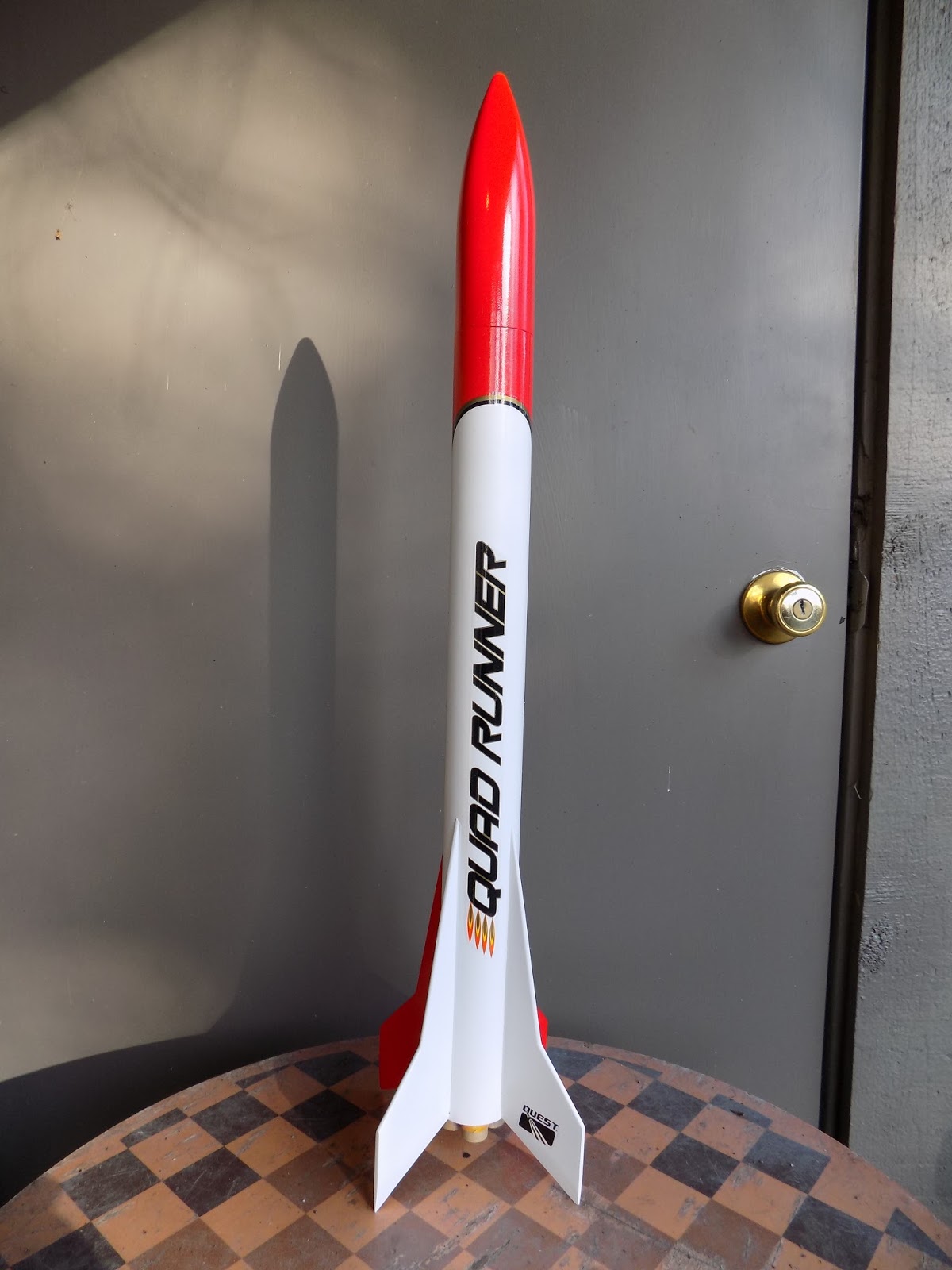
In May, I went to launch some rockets with Chad. I took along several I'd built but never flown before. It was breezy, and I lost a few. Against my better judgment, I put the Quest Quadrunner on the launch pad.


This beauty of a rocket from Quest Aerospace is a four-motor cluster capable of pretty high altitudes for a model rocket. It took me a long time and some heartache to build, but in the end it turned out really beautiful.

I installed four standard EC6-7 motors in the rocket. But clusters are tricky. The trick is getting all the motors to ignite at once. Estes motors (or "engines") all come with igniters, but they're not as reliable as you want for a cluster rocket.


There are a couple problems that prevent Estes igniters from being ideal for clusters. One is their size - they're pretty small and don't have much reach. But the main problem is that they require too much current.

Getting one Estes igniter to fire is one thing, but when you have the current from your launch controller split between two or more igniters, the total current reaching each igniter tip is less and less. What can then happen is that sometimes one motor might fire, and take the rocket with it, ripping out the other igniters before the other motors light.

Quest Aerospace has a much better igniter for this job. It's called the Q2G2 igniter.


These were off the market for a while, but they're back. The supply still can't quite meet the demand, but they are on the market.

Two things make this igniter much better for cluster rockets.

The first, is that the igniter has a black pyrogen on the tip.


This is a flammable substance. When the igniter tip heats up, the pyrogen creates a small flash or flame, aiding in the motor's ignition.

Estes igniters used to have a pyrogen, but they stopped making them like that in the last year. I still have a few, but I save them for special occasions.

But what makes the Q2G2 an even better igniter for cluster ignition is that they are low current igniters. That means it takes much less electric current to make the tips hot enough to ignite the rocket motors. You can send the same amount of current through several Q2G2 igniters as through one Estes igniter, and they will all fire pretty much simultaneously.

I put the Quadrunner on the pad, inserted the safety key into my launch controller, counted nervously down from 5, pressed the ignition button... And there was this loud puffing sound signifying ignition.

And then the rocket just sat there. Fortunately! I'm sure I would have lost it otherwise!

But what had happened?

As you can see in the above photos, the Q2G2 comes packed in a little red straw. This is actually what keeps the igniter installed in the motor before ignition. This is a different method than the plastic plug method seen in the Estes igniter photos.

Quest Q2G2 installed in an Estes C6-7 motor

I really like the straw method. It allows you to insert the igniter until you can really feel that it's in contact with the propellant.

I looked at the rocket. The Q2G2 igniters - all of them - had slipped downward a little inside their straws. The straws were blackened, and the puff of the pyrogen had actually ejected them from the nozzles of the rocket motors without igniting any of the propellant.

OK, so that saved me losing a beautiful rocket on its first flight.

On other occasions, I've used multiple Q2G2 igniters successfully, but only after fiddling around with them, then placing the rocket gingerly on the pad, hoping nothing would disturb the igniters before I pressed the launch button. Then I'd have to rush to launch the rocket before any of them fell out.

Rushing is not a good idea with rockets.

I've got a big launch coming up in a large field, and I'd love to see the Quadrunner finally take flight, and have a reliable ignition system securely in place.

If you've had trouble keeping your Q2G2 igniters staying in place, here's a way to prevent them falling out.

The problem isn't the straw. It fits into the nozzle of the rocket motor just fine. The problem is that the igniter itself can pass too easily through the straw, slipping out before you press the launch button.

Here's what you do:

Cut a very small bit of masking tape.


Wrap the masking tape around the twisted part of the Q2G2 igniter. You don't want to cover the pyrogen head, obviously, and you want to leave the free ends of the igniter free to bend them in whatever direction you need to to hook the leads up to the launch controller.


You want just enough masking tape around the twisted part of the igniter so that it can still pass all the way through the straw and come into contact with the propellant, but that it will have enough of a friction fit that it won't fall out.


Now the igniter is securely installed. Don't worry - it isn't "stuck." When the motor ignites, it will eject the straw and the igniter. But it will ensure you get reliable ignition on as many motors you have in your cluster rocket!

Note: These pictures are for illustration only. You should not install the igniters in your rocket motors until you are on the flying field, preparing for launch!

Edit: As Rich Holmes correctly points out, it's fine to install an igniter at home. It won't fire unless the launch controller is hooked up to it. What I should have said is that you should install the motor in the rocket first, then install the igniter.

Myself, I wait to install igniters until I'm at the pad. I transport my rockets in a big box full of newspaper, and I figure some of the igniters will fall out if I install them at home.

Like my Facebook page for blog updates.

Monday, March 30, 2015

Mask Your Fins With a Skirt

So, you've got a rocket that's to be painted multiple colors. You start with the light colors (the undercoat), then move onto the darker colors (the topcoat).

Here's a cute little scratch build I'm working on - Sounder I.

This color is Rust-Oleum 2X Marigold, if you're curious.
I love this color! But I'm putting a black roll pattern - a black checker pattern - on the upper portion of the airframe. Obviously, I want to keep from getting flecks of black paint on the lower portion of the rocket, so I'm going to mask it off.

I'll use tape to mask the lines where the black will go down, but instead of taping up the whole rocket - which takes a long time and uses a lot of tape - I'll do a large section with masking paper.

The lines are masked off with clear Scotch tape. Masking paper
is wrapped around the body of the rocket and taped in place.
Despite what some kit instructions tell you, do not use newspaper. I learned this the hard way. The print will transfer to your paint job, like Silly Putty. Nobody wants to see Marmaduke end up on their rockets. Any plain paper will work fine. Brown masking paper comes in long rolls, and can be bought at hardware stores.

Now, you could take the time to carefully wrap all the fins with tape and paper, but again, this is a lot of work. I prefer to make a masking skirt from a plastic shopping bag.

To do this, you need a plastic bag - and I'm sure you have a whole bag of bags in a cabinet somewhere - a pair of scissors, and tape.


Make sure there are no holes or tears in the bag, or you'll have to tape those up.

Start by cutting a small slit in the middle of the bottom of the bag. You'll probably need a smaller slit than you think.


Open the hole in the bag, and slide the bag down onto the body of the rocket, bottom up.


Tape the skirt in place using a couple of pieces of tape.


Now, twist the skirt around the masked area of the rocket, and tape off any gaps.


Finally, twist the bottom of the bag closed and tape it shut. If you're using a painting rig like mine, where the rocket is held by a stick from below, you can tape the skirt to that. If you're using a paper wand, you can either tape the skirt to the wand (if you have it coming out the bottom or aft end of the rocket) or tape the skirt shut completely (if you have the wand coming out the top or forward end).


Now your fins are masked safely, and you've spent a lot less time.


Paint away!

Like my Facebook page for blog updates.