Showing posts with label n00b mistakes. Show all posts

Friday, May 27, 2016

The Future Experiment


Click here for the previous post.

As detailed in my previous post, I recently completed the Estes Reflector, and despite a few bad turns during construction, I managed to make the rocket look pretty nice.

But I wanted to try something I'd read about online - giving the rocket a nice shiny, protective coating, using Pledge floor polish "with Future Shine."


Rocketeers often refer to this stuff simply as "Future."

The rocket was already pretty shiny before I tried this. I used some Krylon gloss white enamel for the undercoat and some Rust-oleum red gloss enamel for the fin can, and other than a few spots where I wet sanded the paint to remove some flaws, the rocket looked pretty good. But I needed to test this stuff out before trying it on a rocket which was more precious to me.

One reason I decided to try this application is that I thought it might be a good, easy way to seal waterslide decals in place with a shiny, protective coating. Perhaps it would also turn out to be an easy way to fix a less-than stellar paint job. With the troubled history of this rocket, and the fact that I tend to fly my larger models more frequently than my smaller ones now, I was willing to risk making a bit of a mess with this rocket, to see if it was as easy and effective as it sounded.

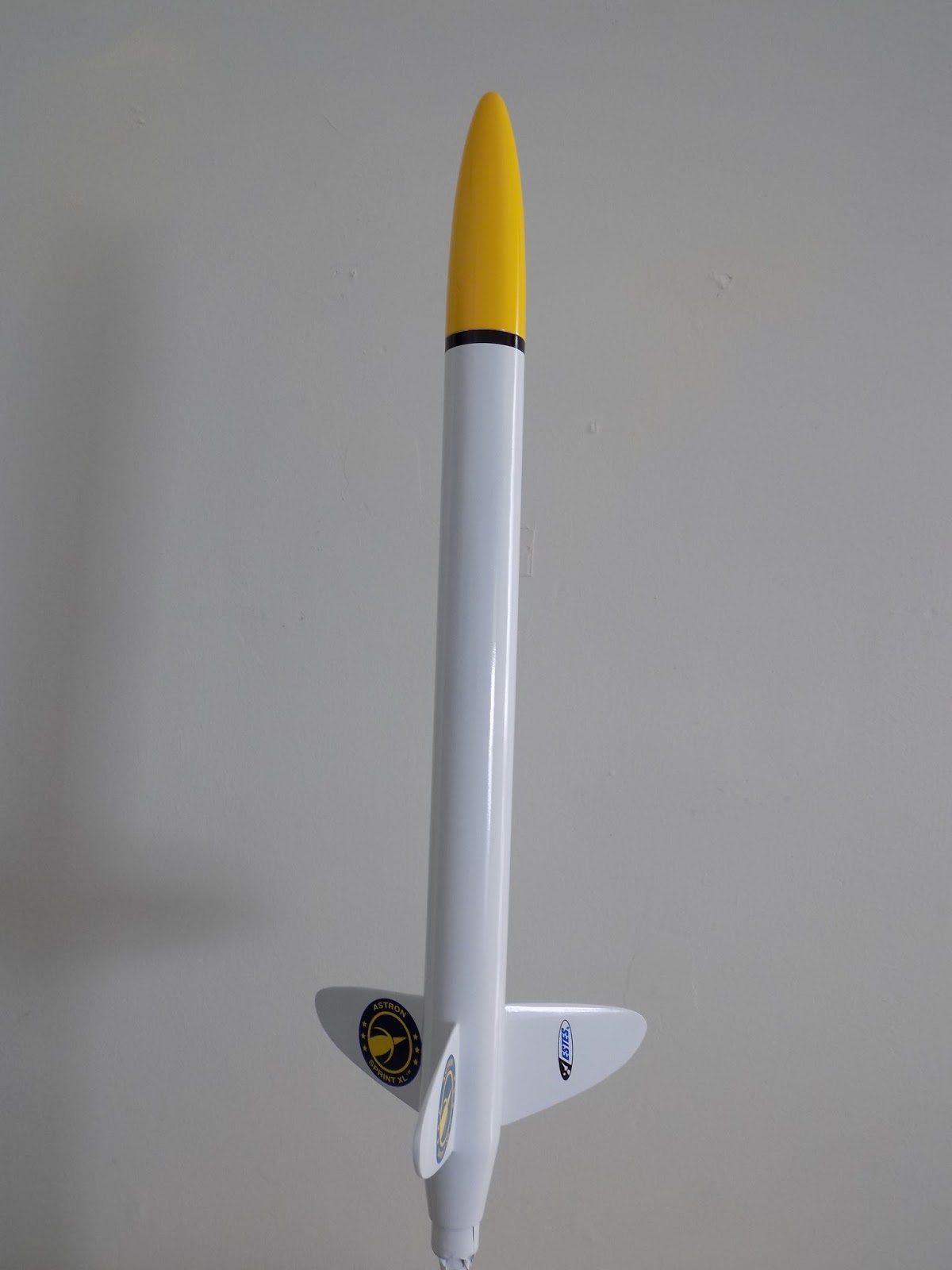
I have gotten some pretty good results on my rockets lately. My Estes Astron Sprint XL clone turned out to be as smooth and shiny as any rocket I'd ever built - darn near perfect.

My Estes Goblin, too, had turned out very nice.


But I thought I might like to add a clear protective layer to seal and protect the decals.

On the Astron Sprint XL, this would have been a good idea, as the black band near the nose cone has since started flaking off, and I haven't even flown it yet. I'll need to take that decal off, and paint a black band on.

A gloss clear coat - clear spray paint, that is - is an obvious choice for sealing and protecting decals. But I put in a lot of work on these paint jobs, and it included a little bit of wet sanding of tiny flaws in the paint, followed by polishing the rocket before adding the decals in the first place. What if my clear coat came out bumpy and irregular? I'd be hesitant to sand it smooth, as I might sand through it and into the decals. I'd rather put nothing on these rockets than ruin my work. Perhaps Future would be a good solution; it certainly sounded that way, from what I had read. But I wasn't about to do it on my best builds without testing it out first.

* * *

Before I get to the Future experiment, a word about the build, for those of you who may be building a small payload-carrying rocket like the Reflector. There are several of these model rockets, and they're pretty popular.

The face card of a lot of these little payloaders touts their "huge payload section." While it may look spacious on the outside, inside the payload compartment is another story.

The payload section is made up of a balsa nose cone at the top, a length of body tube in the middle, and a balsa transition at the bottom. The transition allows the diameter of the rocket to get wider at the payload section than the main airframe of the booster. The payload space is therefore inside the body tube, between the transition and the nose cone. As with all model rockets, the nose cone and the transition have shoulders - lengths of balsa slightly narrower than the base of the nose cone or the top of the transition - which allow you to fit them into the payload tube. The shoulders have to be long enough so that the payload section stays together in flight. What you end up with is a space only about an inch long at best inside the payload section.

The payload space inside the Reflector. Image from this Instructables project.

Not a lot of things you might want to fly will fit into that little space, but you can't simply cut the shoulders off and call it problem solved, or the rocket won't stay in one piece for flight. I wanted to be able to fly my Jolly Logic Altimeter 2, which is about 2 inches long, in this rocket.

What I did to accommodate the altimeter was to cut off about half the shoulder on the nose cone, and just a little off the upper shoulder of the transition. I left enough on the transition so that I could still get a good friction fit between the payload tube and the transition shoulder.

The big piece is from the nose cone shoulder. The thinner piece is just the conical top of the transition shoulder.

The transition piece still has enough length to be safely friction fit into the payload tube.

The nose cone would have to be glued on. There simply wouldn't be enough shoulder there to keep the parts together securely. When opening the payload, the nose cone and payload tube are now one piece.

But there still wouldn't be quite enough room. Using a drill, I carved out a little niche into the shoulder of the nose cone. Now the altimeter just fits perfectly into the payload section.


See it in there?

When you use a payload section like this, you might need to wrap some tape around the shoulders of the transition and nose cone (if you didn't need to glue it on) to get a nice snug fit with the payload tube. You don't want things to pop open during flight and lose your altimeter!

Also, it's best to drill a couple small holes, called static ports, into the payload tube. Altimeters use barometric pressure to measure altitude. The payload section needs to be ventilated so the air pressure inside matches the air pressure outside the rocket. Anywhere from two to four holes is recommended. For this small payload section, I drilled two holes, on opposite sides of the payload section, each one 1/16 inch in diameter. If you have a larger rocket, you can do a Google search for "static port hole size" to figure out how big and how many static ports you will need.

Back to the Future experiment...

* * *

When trying out a new material or building technique, it's always a good idea to try it out on something inexpensive or replaceable before committing to doing it with a rocket that's really dear to you. First, you want to make sure you've understood how to do it correctly. Sometimes you misunderstand the directions the first time you read them.

Also, sometimes a new skill isn't as easy to a beginner as it is to someone who uses it all the time. My first attempts at using paper skins to reinforce and hide the wood grain on fins were disastrous, and I still haven't quite gotten the technique down, even though a lot of people swear by it, and find it really easy.

Thirdly, sometimes a thing doesn't work - at least, for you - they way they say it will, or the way it works for them.

I'd heard of using Future a few times before, but the most complete explanation I had found was on this thread on The Rocketry Forum.

It seemed pretty straightforward, and the basic steps were as follows: Get some Pledge with Future Shine acrylic floor polish and a clean spray bottle. Optionally, add a little bit of Simple Green cleaner (which I didn't use). Make sure the nose cone is separated from the body of the rocket with a little tape, and spray the rocket down till completely wet. Go back several minutes later to remove any drops hanging from the bottom of the rocket with a paper towel, so they don't harden there. A day later, you'll have a shiny rocket.

It seemed to make sense, and it sounded so easy! This could be great! I thought. This could change everything.

What I pictured happening was that I'd spray the rocket down with the Future, it would level out and all the excess would drip off, and I'd have a nice, even, smooth, shiny protective surface over the whole rocket.

What happened when I tried this was different.

First of all, though I did blot off the excess that was dripping down off the base of the rocket, I still got a little pool of material on the trailing edges of the fins. As the Future started drying, it became gummy, and I ended up with some uneven, gooey bits. Attempting to dab it off with a paper towel, I merely made it more uneven.

Look closely, and you'll see a gooey drip slowly hardening on the corner of the fin.

The payload tube also experienced some swelling. You'll have noticed the spiral grooves running around the outside of the body tubes when you build your rockets, and perhaps you've filled those in, as I do, with wood filler.

There's a second spiral groove, running around the inside of the tube. I'm not sure how, but the Future seemed to have gotten inside the payload tube, and the internal groove started to bulge outward.


 The bumpy texture here isn't due to the Future. It's orange peel, and it's a flaw in the paint job that has nothing to do with applying Future. It can be sanded out and polished, but after the trouble I had with this build, I decided not to bother. But you can see the internal grooves bulging through the body tube after Future was applied.

According the the directions of the post, the nose cone is supposed to be set loosely on the rocket, or the Future will wick in and glue the nose cone to the rocket. In my case, the nose cone was glued on, so it was the transition I had to worry about.


First, I neglected to pull the payload tube apart from the transition before spraying, so that got stuck. But even having loosened the transition from the main body tube and masked it with tape, the whole thing still got stuck together.

Once the Future was dry, I tried to pull the payload section off the rocket, and it was firmly glued on! I was determined to get it off there, and while I did get it off, I ended up crushing the body tube slightly and damaging the decals a little from pulling so hard.


I got the payload tube and transition separated after wiggling a hobby knife and a fingernail into the joint. There was some slight damage there, but it was minimal.

Rather than leveling out and running off smoothly, the Future dried on the rocket in streaks. Some droplets didn't run off at all, and in fact hardened into acrylic blobs which won't come off the rocket.

Streaks, looking a bit like sweat, can best be seen on the left-hand fin.

Hard blobs of dried polish, the result of droplets which did not run off or self-level

The streaks and blobs may be removable, with the use of water and ammonia, but that would most likely take off the decals.

The one thing this does seem to have done is to seal the decals to the rocket - and if you look closely, you can see that I had a few loose edges which I was unable to burnish to the rocket surface, so this may at least prevent those from peeling off.

But overall, my first attempt at trying this out was a little detrimental to the final appearance of the rocket.

* * *

So, what could I do differently next time?

Well, I could decide that this technique isn't for me. I have been getting better at getting a nice smooth paint job lately, so perhaps I don't need this one.

Or, I could try again, but go about it differently.

On asking advice on the Rocketry Forum thread to which I linked above, I found a few different opinions (you'll always find a dozen different opinions when you talk rocket building with people). But one thing that a lot of people seem to agree on is that what I did here was too much. If and when you use Future, you need to do so lightly!

Some people suggest spraying the Future on, but in multiple light coats.

Some people suggest using a foam paintbrush to apply the future in a thin, even layer.

Perhaps spraying it on and wiping it off with a clean cloth would yield good results.

In the comments section of my previous post, Chris Michielssen says that while he uses Future on his builds, he only applies it to the decals, and he uses a Q-Tip to apply it in a thin layer.

Whenever you try out a new technique, the point is that sometimes you have to test it out first. Some things seem a lot easier when you read about them than they are in practice. It may take practice to get the hang of it. Even with something as simple as applying a little Future with a cotton swab, now that I've had this experience, I might first try it by applying a spare decal to a painted surface, and then sealing it to the surface with Future, just to see what it looks like (rather than doing it on a finished rocket for the first time). If I like the results, I may adopt the technique.

* * *

Applying Pledge with Future Shine to rockets to improve their surfaces isn't a terribly common practice, but some people do swear by it, so they must be on to something. At the very least, they like the results they get with it.

Others say they would never use floor polish on a rocket.

Floor polish on a model rocket? Not no way, not no how!

People in both camps are doing what works best for them, so nobody is wrong!

As you look for ways to improve your building, sometimes you'll come across techniques which are a tad controversial. Some rocketeers are pretty opinionated about what works and what doesn't, what you should always do or never do. We'll talk about one of those techniques in an upcoming post, and look at both sides of the issue (and try not to raise any hackles or ruffle any feathers).

The point of all this is, when you learn of a new building technique or material, you don't have to take anybody's word for it. Whether one person says "This is easy and amazing!" or another person says "Only an idiot would do this!" you will only know what works for you if you try something out. Just don't try it on anything too expensive or irreplaceable.

Like my Facebook page for blog updates and extra stuff.


Monday, May 23, 2016

Perfecting Your Rocket Building Skills Can Be Scary


I'm trying an experiment today, and it's got me nervous.

The rocket you see above is the Estes Reflector, a small, BT-50 (0.976 inch diameter) payload-carrying model rocket with a classic "model rocket" look to it. It's... not a big deal. I keep telling myself that.

I bought the Reflector when it was on deep discount, partly because I was considering building this model rocket camera payload project from Instructables.com, and the Reflector happens to be the rocket used in the project. I decided to simply build the rocket as a stock kit model, though I did drill a couple static port holes in the payload compartment so I could use an altimeter.

I'm not in love with the Reflector - I keep telling myself that. It was just a cheap, simple payload rocket I got so I could play around with it.

While writing this, I realized that this was the first rocket I started building after my move from Indiana to Boston last summer. I've been working on this little rocket since July - ten months. Which is far too long to spend on a little model rocket like this. It's not a big deal. I keep telling myself that.

To be clear, I have started and finished other rockets in the last ten months. And a lot of things went wrong on this build, so I really shouldn't care if it turns out alright. I keep telling myself that.

To begin with, the fins warped when I filled the wood grain with Carpenter's Wood Filler (CWF). I got them back to mostly flat, but when sanding off the filler, I had a hard time getting the darned things smooth. Photo not found.

While attaching the fins, I realized that the thumb tab from the motor hook would have prevented the rocket from standing upright on its fins for display, and I didn't like how far out the hook stuck from the back of the rocket. So, halfway through attaching fins, I tried to clip off the thumb tab. But I didn't have the right tool, and ended up bending the tab badly.


This is partly why it took me so long to complete building the Reflector - I kept screwing it up!

Unfortunately, I didn't take many pictures of the Reflector build. Since I was having such a hard time with the rocket, I thought I might never finish it, and didn't really see how I'd use it on the blog, and kept telling myself the rocket didn't matter that much. It was a slightly screwed up rocket that I'd probably never finish, and if I did, it probably wouldn't look great.


Once I'd started and finished a few other rockets, I decided I needed to get the Reflector built. Each problem I'd created, I seemed able to fix more or less. With plenty of automotive filler primer and lots of sanding, I was able to get the fins relatively smooth. They weren't badly warped - just enough so I had been unable to get all the texture of the wood filler sanded off with a sanding block. Using just a piece of 400 grit sandpaper and my fingers, I got them to where I found them acceptable.


Suffice to say that it took me ages to decide how I wanted to fill the wood grain on the balsa wood nose and transition piece. I'd never used a balsa nose before - this was my first! I didn't know if I wanted to use wood filler, creating dust, possibly leaving the pock marks I occasionally don't notice in the surface until the rocket is painted; or sanding sealer - a model rocketry standby that I've only recently started playing with; or something else.

I opted for the CWF. Turned out alright, especially after spraying on the primer and sanding it smooth. Almost as perfect as plastic.

Fast forward to the painting process. The white went on with little trouble, though I did have to sand a few flaws out of the first layers of white and touch them up with a new can.

The black nose cone and payload section got some orange peel on them - a bumpy texture you sometimes get with spray paint, so called because of its resemblance to an orange rind. I considered sanding it smooth and either repainting or trying to polish it, but decided I shouldn't spend so much effort on a rocket which wasn't that amazing and which had already caused me trouble.

Then came the red fin can...

Ugh...

Because of the payload section, the launch lug has a wooden standoff, and if you put the launch lug where the instructions tell you to, there's not much room between the leading edges of the fins and the trailing edge of the launch lug standoff. That means that in order to get a clean, straight line of tape down where you want the red bottom to stop and the white upper part to start is tricky, because there's almost no space.

I usually use clear Scotch tape to mask lines on rockets, because it's cheap and leaves a nice, sharp line.

I used Chris Michielssen's trick of marking a piece of tape with permanent marker and cutting through the black with a hobby knife and ruler to get a sharp, narrow piece of tape.

Getting a piece of tape perfectly straight around a body tube to create a seamless, perfectly straight circumferential line can be tricky. It took me several tries and three pieces of tape to get it right. You're never really sure until you take the tape off.

Once a narrow tape line had been laid down, I had to construct a mask, using blue painter's tape to protect the launch lug standoff from overspray, and paper to keep the rest of the rocket clean.

(I really wish I'd taken pictures here).

When you mask off a base coat to apply a second color, you first want to seal the edges of the tape down with a thin layer of the original color. My fins would be red, but I'd seal the edges with a blast of white.

It turns out that Sharpie markers, the kind I had on hand, while "permanent," are not the best markers for this application.

The white Krylon paint melted the sharpie, and I got a gray ooze down the rocket. Also, I got minor paint runs from doing too heavy a coat of paint.

No matter! I told myself. This rocket was doomed from the start! It. Will. Still. Fly...

I went on to do the red top coat. It was actually going not too badly. A bit bumpy, but not quite orange peely, and pretty much OK. The paint runs were hard to see, so I figured it wouldn't be a big deal.

While the paint was still tacky, I began taking the mask apart, starting with the paper, moving on to the blue painter's tape, then finally, carefully peeling back the Scotch tape at the edge, all while trying not to touch the fresh paint on the fins.

Then the Scotch tape tore.

I could not get all of it off. I have a little bit of fingernail, but I could not lift the tape off. As I became more and more frustrated, I found I was smudging the edge of the paint, getting fingerprints in it, and making a big mess, but I was getting angrier and angrier, and was not about to let the paint dry with bits of tape stuck under the edge of it. (I get really frustrated when I have something stuck to a rocket and can't get it off).

This was the result.


From the side, you can see how little room there is between the fins and the standoff.

I nearly smashed the rocket with my bare hands. HA HA HA!! WHO CARES?? I NEVER LIKED THIS ROCKET TO BEGIN WITH!!!

The problem with being a perfectionist is that you don't have the luxury of not caring. Even if you're building a little rocket that was inexpensive, and maybe not your favorite, is that the process of building is such a pleasure, especially when it's going well. If it goes badly or if you make a mistake, you might tell yourself that you don't like that rocket, and you don't care how it turns out, but it bothers you. Then, if you're able to fix the problem, you are back to feeling good about the project.

One thing I've realized when building this rocket is that, even if it's not my favorite, one that I'd been eyeing for months on some website, dang it, I do care about this rocket. There's no rocket build, large or small, where I decide I don't care.

But sometimes, to develop a craft, you have to take the risk of ruining your work in order to try a new technique or skill, or even to practice techniques you already use. I've only been doing this for going on two years now, so I'm not an old hand yet. I'm still the Rocket N00b.

Also, when you make a mistake, sometimes if you set the rocket down, breathe, and think about it, you can fix things. Even this.

First of all, in my frustration, I'd gotten some pink marks from fresh paint on my fingers all over the rocket. No problem. I grabbed a Mr. Clean Magic Eraser (a tip from Chris Michielssen), and got rid of that.

Those red smudges were sticky the next day. That told me that there was mushed up tape mixed in there. I knew how to take care of that. The dark marks were either primer (I did take a hobby knife to the rocket while trying to remove the tape) or Sharpie. Again, I had a plan.

Mushy adhesive stuff can be removed from dry paint (test before you try on your rocket, but it has worked for me) with a little Ronsonol lighter fluid (as you'll see I found out if you clicked the link above leading to the Quest Quadrunner post). I dabbed a little on a Q-Tip and got most of the gummy red off. It also loosened up the few little bits of tape I discovered once I cleaned off the gummed-up red bits, which I was able to carefully lift off with the tip of a hobby knife.

I finally wet-sanded the edge where the red meets the white with either 600 or 800 grit wet/dry sandpaper.

This was the result.


Not perfect - but much better than what I'd had before. Also, you can see that I got that tape line perfectly straight, so that was encouraging. Smaller rockets are harder to build, because the details are harder to get right.

There is a black decal which goes around the rocket just below the launch lug standoff. You're supposed to leave a bit of white between the black and red, but in this case, I decided the decal would hide the flawed edge. It would be slightly different from the stock look of the rocket, but it would look better this way, and that one little detail would make it my own.

I finally ended up with a rocket which didn't look too bad, considering everything that went wrong. I could have left well enough alone, but I decided to try one more thing. Not that I don't care about this rocket, but I figured this one, with all I messed up and all I was able to fix, would be the ideal candidate to try a treatment I'd read about, before using it on a rocket I really cared about.

The experiment I'm trying is to make the rocket shiner, using Pledge with Future Shine - a floor polish which is said to give a high gloss shine to your rockets, and I hope may seal the decals in place and protect them from damage.


Doing something I've never tried like this is a little scary. The Reflector has gone from being a problem build to a pretty nice looking little rocket, and now that it's done, I don't want to mess it up. But I really don't want to try it for the first time on a more expensive rocket or one I'm really attached to.

How will it turn out? We'll see in the next post. But sometimes you gotta break a few eggs.

Like my Facebook page for blog updates and extra stuff.

Follow me on Twitter.

Saturday, August 1, 2015

Horrible Error

I've started building my first rocket in months. I decided to take one of the smaller rockets off the build pile - the Estes Reflector.


It's a small, BT-50 (24mm) based rocket with a short payload section. I'm building it with the intention of adding a camera to the payload, following the instructions on this Instructables build, because it's a pretty cool project, and I have yet to successfully launch a camera payload (Janus II had a weird flight and vanished without a trace, and the camera wasn't working anyway. I may post video soon.).

An Estes Reflector with internal, horizontally-
oriented camera, from Instructables.com


Despite having become much more confident in my building skills, sometimes mistakes happen.

Well, first of all, I airfoiled the fins, and one or two came out a little uneven. Not badly, and I hadn't done it in a few months, but the problem was due mainly to rushing the job.

Then, a couple of the fins warped when I brushed on CWF to fill in the wood grain. I pressed them under a heavy book (my trusty Riverside Shakespeare, an invaluable rocket building tool), but there was still a nasty warp on one of the fins. I dunked the bad fins in water, and am re-pressing them. We'll see how that turns out.

The real problem is the motor hook.

Like most Estes low power kits, it comes with a standard motor hook with a little recurved bit on the end as a thumb grip.

From Apogeerockets.com
Some rocketeers religiously remove the thumb grip and smooth off the remaining bit with a file. I actually like the thumb grip - it makes it easier to install the motor. But in some cases, it gets in the way.

A lot of rockets with backward-swept fins will sit nicely on a shelf with no need for a stand or support. Many rockets have fins that don't sweep backwards, so in order to display them on a shelf in a convenient, upright manner, you need to make (or buy, but don't ever buy) a stand of some sort.

The Reflector has swept back fins, but they don't go too far back. On a standard Estes motor hook, the thumb grip is longer than the fins, meaning you cannot simply rest the rocket on its fins. On an old-fashioned, simple motor hook, which is basically just a strip of metal with a bend at the front and a bend at the end, you'd have plenty of space at the bottom - no need for a stand.

Here's a picture from Chris Michielssen's blog with a before and after pic of a modified Estes hook:

The top hook has been modified, and looks more like an old-fashioned
motor hook. This is the kind of hook you get when you order parts online
from vendors such as Jonrocket.
First, I tried cutting the thumb grip off with a pair of wire cutters.


I've had these probably since I was 12. I've used them for trimming guitar strings for 29 years. They didn't work... Didn't even make a dent.

Looking around my Rocket Room...

My Rocket Room in Boston - a couple weeks ago, in progress
...I found a pair of PVC pipe cutters.

This evil parrot-looking thing cuts through 1 inch PVC pipe with little effort.

I figured these would have more power. But instead of cutting the hook, it bent it - backwards. Now there was no more hook to the hook. It wouldn't hold the motor in - but of course, the thumb grip was still attached. AND I dented the end of the airframe, slightly...


I reached for a pair of needle nosed pliers to try to re-bend the hook into shape. What I ended up with looked like this:


It will hold the motor in, and the hook is now definitely short enough to not extend beyond the aft end of the fins, but it looks pretty janky. And the thumb grip now sticks out beyond the diameter of the airframe. This could catch on a two-piece Estes launch rod. Chad had that happen with a bent motor hook on his Estes Crossfire ISX once, and the rod went flying with the rocket! It was terrifying.

Fortunately, I do not use the two-piece rods, and, because of the payload section, the launch lug for this rocket is actually on a stand-off, so it's not likely that the rod will come into contact with the hook.

I could have tossed this whole thing out. I do have plenty of spare parts. It would have been easy for me to cut a 10-inch piece of BT-50 body tube, and make a whole new lower section of this rocket from scratch. But I wanted to go forward, not backward, and as you can see above, I went ahead and started gluing on the fins.

This kind of laziness is not like me - not in rocketry, anyway. I'm usually very meticulous with my rockets (if only I could be that diligent in other areas of life). But it's been so long since I built a rocket, I wanted to move quickly.

If I had it do do over again, I'd have saved the Estes motor hook for another rocket, swapped out a plain hook from Jonrocket, and have saved myself the trouble of all this. Live and learn!

I'm sure I can still make this rocket look pretty good, and when I'm done, the flaw won't be noticeable. Perhaps I'll even find a better cutter to take care of that hook later.

Like my Facebook page for blog updates.

Sunday, December 28, 2014

Adventures In Painting - the Quest Quadrunner

I tend to write really long posts, and this is no exception. But, if you're new to rockets, I hope you find something of value here to use in your rocket builds. If you're more experienced, I hope you at least find this amusing.

I'm finishing up one of my three latest builds - the Quadrunner, by Quest Aerospace. This is a cool-looking rocket, and has a cluster of four motors - that's a lot of thrust, fire, noise and smoke compared to what I've launched in the past.

Check out what the kit looks like:

I'd been eyeballing this rocket for some time. I loved the idea of clusters, even before I'd tried them out. My first was the Quest Magnum Sport Loader, which was a lot of fun. Even with only two motors, you get a much more dramatic launch than with a single motor.

Here's the video of the Magnum launching on two Estes C motors - slo-mo at the end:

The Quadrunner is a little pricier than the standard basic kits I'd built in the past - about $45. I got it for less, thanks to an Amazon gift card. But I was nervous about building this rocket. It's more complicated than a Skill Level 1 rocket, and I really wanted to make it look good. It has, of course, the cluster of four motors, which means that putting together the motor mount is more complex, and needs to be more precise than a single-motor mount. You need all four motors to be perfectly aligned.

The finished mount
This means measuring and gluing precisely, and then rolling the whole thing across the table to make sure it's not wobbly.

There's another part that goes in the middle - it holds the bolt in place you see in the above photograph, which will hold the motors in - this is in place of the usual hooks most beginner's models use.

This meant threading the bolt through two diamond shaped bits, attaching a Kevlar shock cord to the top, then pulling the whole thing through the middle of the four motor tubes - then gluing that in place.

This little bit keeps the motor retention system in place, and is key to assuring your parachute ejects. And it's a tight fit.

It requires some precise sanding to make it fit, and without a precise fit, the ejection gasses from the motors will escape out the back of the rocket. The nose cone won't come off, the parachute won't eject, and the whole thing will come crashing down to earth and destroy all your work.

Then there are the fins. They're two-part fins which you have to glue together to make one piece - something I was nervous about, as I was pretty sure it would be easy to get them crooked.
How on EARTH was I going to get these perfectly straight? And how was I to round the leading edges, with that
joint right there?? This was an area I really could have screwed up this build and made a shabby-looking rocket.


The joint here needed to be pretty close to perfect.


I thought of several options, since in the directions you're meant to lay them flat on waxed paper to glue them together flat. I thought no way that's gonna come out straight - it's gonna dry crooked! I finally emailed Chris Michielssen of the Model Rocket Building blog, to ask what he'd do if he built this rocket. I hadn't found any references to the build on his blog, but I knew that if anybody knew what to do, it would be him.

He gave me some advice - turns out he had built this rocket. He said that gluing them flat on waxed paper was a good idea, and then putting a book on top would keep things straight. I sanded a rounded edge on part of the fins, then beveled the trailing edges, and put them together.


So far, so good.

I took all the steps I've learned so far to make the rocket look (and fly) great - carefully filled in those spiral grooves in the paper body tube, filled and sanded and filled and sanded and filled and sanded the fins, attached the fins to the body as carefully and precisely as I could...

Ted Macklin's guillotine fin jig...


Totally worth the money I paid for it.

Hi, Ted!
I got the fins down perfectly, with no gaps between them and the body tube. Made the best glue fillets I'd ever done - I mean, guys, this thing was looking really solid. Carefully filled the seam in the nose cone with some plastic putty, then refilled when I saw a little divot in the putty. Got the thing as smooth as possible.


Was I going to let this little flaw in the nose cone go unfilled? Oh, no I was not!
Up to this point, I was really proud of what I'd done. I had to take it slow, but I hadn't made any major errors I was bothered with.

Then, I had to wait to do the painting. Or, so I thought.

It's been cold here in Bloomington, and my understanding was that you should never spray paint if it's below 50 degrees Fahrenheit. So I waited.

Then, on a warmer day, I primed the rocket. I used a new primer to me - Rustoleum Sandable Primer. I always use primer that's "sandable," but had never used "Sandable Primer."


Actually, this was my first mistake. It turned out fine, and I really liked the primer. But I had intended to use Rustoleum Filler Primer. This stuff has a "build" to it, and apparently it can fill in flaws in your work. I believe it's used to fill in gouges in a car's paint job. I had a few spots I wanted filled on the fins, and a few weeks ago when shopping, I had been looking at both the Sandable and the Filler Primers. I thought I got the Filler stuff. I realized only after priming the rocket that I'd gone home with the Sandable stuff.

Never mind - it worked great. A few minor flaws that perhaps could have been fixed with the Filler stuff, but after some rigorous sanding, it still looked pretty good.

Warmer than it looks - time to prime


Primed and sanded, ready for painting


Round about this time, I got a suggestion on The Rocketry Forum that you can, in fact, paint when it's cold outside. You warm the paint can with some warm water, run outside with the warm paint and rocket, do a light coat of paint, and bring everything inside to dry and warm up for a few minutes between coats.

I had a launch scheduled for Saturday (cancelled, in the end, due to rain), and I thought I'd have time to finish this rocket by then. I always like having something new to launch each time, because I don't have any other rocketeers to fly with - I launch with friends who are only interested because I try to make it fun for them. Basically, every launch I do is a kind of "demonstration launch," and I'm secretly trying to get one of my friends interested enough to start building and launching, so I have someone to talk rockets with.

I wiped the rocket down with rubbing alcohol to rid it of any dust, and did my undercoats of white. The rocket looked great. No problems due to cold weather - a nice, smooth, shiny finish.

It's hard to light a white rocket indoors, but you get the idea.
After letting the white cure for two days, I was ready to paint the red top coat.

This is where the trouble started...

Now, I was going to include this paint job in a post for my fellow rocket n00bs on the fact that you need to plan certain parts of your build, particularly painting, to avoid a messy job, and to keep from being frustrated. In the process, I learned that I have a lot to learn about certain materials with rocket building...

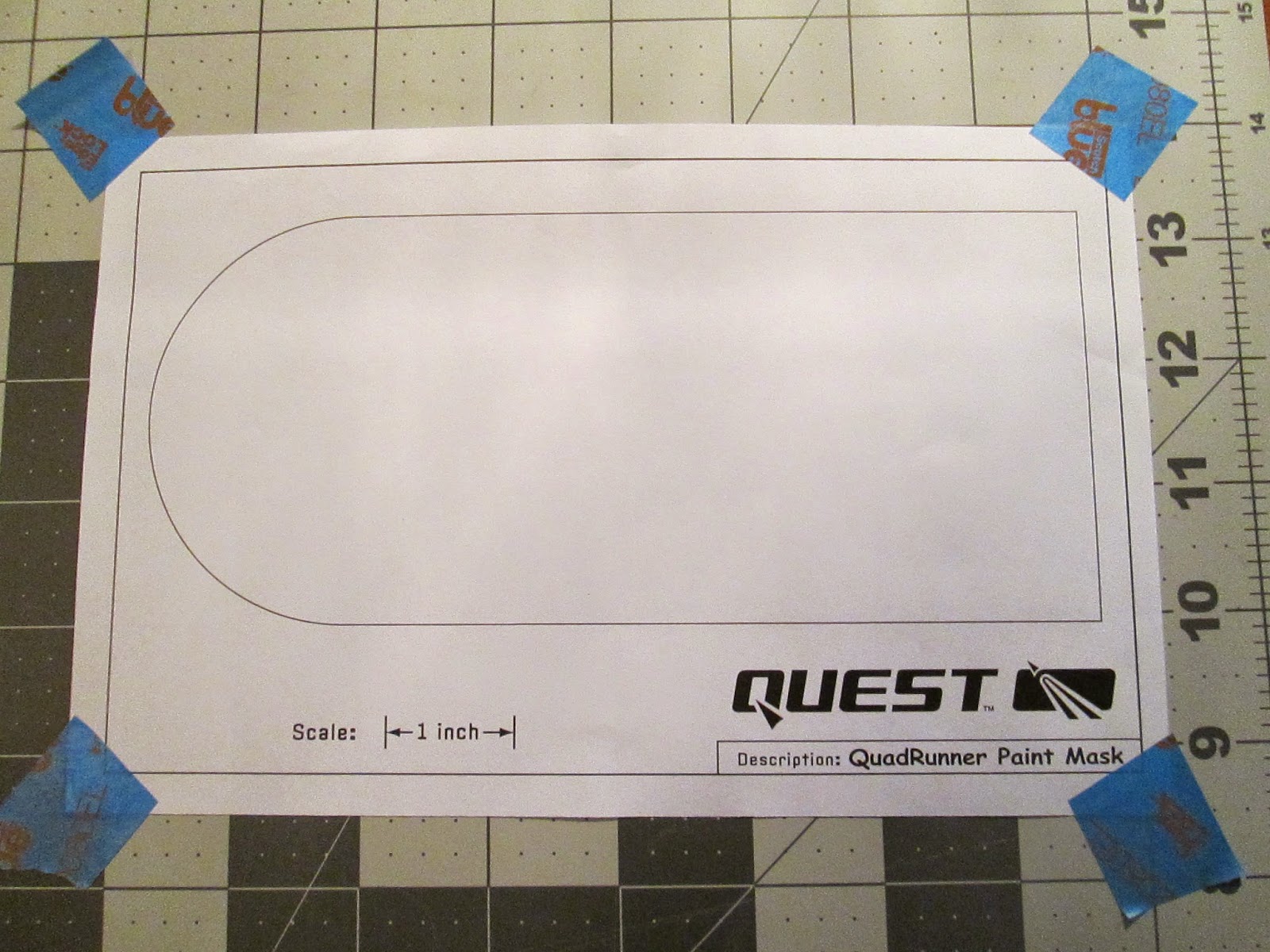
OK, so the Quadrunner comes with a paper mask for painting.


You're supposed to cut this out and apply it to the rocket, with the round half at the top, 1 5/8" from the top of the body tube, then extend the side lines of the mask down to the base of the rocket with masking tape. Then you mask off that whole section with tape and paper, spray the rocket red, and when you're done, you should have a beautiful half-red, half-white rocket with a nice round part near the top of the white side.

This presented a challenge. How could I be sure to get the mask centered and straight? If I applied it the correct distance from the top, how could I be sure that the part of the round top I started with was even the true center of that bit?

Well, I thought about it a bit, and came up with what I think was a pretty good plan, and I thought this is perfect blog material, too! What a smart guy I am!

First, I measured the bottom of the mask, finding the center of that line. Then, using a right angle, I drew from that point up the center of the mask, through the top.


To check my work, I did a little geometry to find the center of the semicircular top - and you can see was off by just a little bit. I made sure the line was straight up the center from the bottom to the top, and carefully cut out the mask.

I cut up the sides with my hobby knife and a metal ruler. I tried to rig up a tool to do the top round cut precisely, using my high school compass and my hobby knife. I think I found this idea in an old Estes or Centuri rocket design publication I found online.


This didn't work as planned, so I just carefully cut the top out with scissors. Not to worry - the black and gold stickers would probably cover any minor imperfections in the shape.

Then I found the centerline between two fins by measuring the distance between the leading edges of the fins and making a mark with a pencil. Then I drew a line all the way from there to the top of the body tube, and on that line, I put a mark 1 5/8" from the top.


Now I had a line on the rocket, and a line on the body tube. If I could get those lines to match up with the top of the mask at that little 1 5/8" mark, I knew I'd have the mask centered and placed correctly, and we'd be good to go.

See? This should work great!


I still think this is a good idea, despite what came next...

To apply the mask, temporary spray adhesive is called for. I have some Elmer's Craft Spray Adhesive, which is either temporary or permanent, depending on how you apply it.

I applied the adhesive to the back of the mask, waited three to five minutes for it to be less tacky, then applied it to the rocket. Success! I got it on perfectly!!


Then I built a beautiful, elaborate mask. It fully covered everything, yet would be easy to remove when I was done painting. I was feeling pretty good up to this point. Why was I so worried about this rocket? Now all I had to do was paint - this would be a cinch!


Doesn't look like everything's covered, because the edges are Scotch tape. But this was
a masking masterpiece, guys. Perfectly aligned edges, full coverage... Great work.
Then came The Ordeal.

To seal the edges, I did a quick pass of the white paint first. Then, to my horror, the edges lifted away from the rocket and began to curl up. Gahh!!! Stop it! Stop it!!


There was no way around it - I'd have to stop my work, remove all the masking, and start again the next day.

I carefully peeled everything off, and laid the paper mask flat. It was a little wrinkled, but the edges were mostly fine, so when it was dry, I laid a book on top of it to flatten it out and left it overnight.

I figured I hadn't used enough of the spray adhesive. So the next day, as soon as I got home from work, I started again. This time, I made sure to get plenty of adhesive on all the edges, and reapplied the mask. Then I built up the whole brown-paper-and-tape masking apparatus and started again.

Here's where I grew impatient. I skipped the white sealing coat (not best practices, but not what led to disaster), and went straight for the red. And what a red! Rust-Oleum 2X Apple Red - bright, shiny, smooth... This rocket was looking beautiful.

I waited for about ten minutes, then began removing the mask. I pulled off the tape and the paper, and the fins were a brilliant white. The line was clean and neat. I pulled off everything but the paper mask... and then the mask wouldn't come off!

I used fingernails and lots of swearing, but the thing wouldn't budge. I even tried to gently, carefully slide the tip of my hobby knife underneath the mask to loosen it. Nothing!!

Look at this monstrosity!

This obscenity!!

This abomination!!!
 
After getting only tiny pieces of this mask off and gouging some of the white paint in the process, I took to The Rocketry Forum for help.

I went from happy to pretty desperate very quickly. What should I use? Water? Goo Gone? Razor blades?? After several more attempts to just coax the thing off, I'd scratched through in a few spots to primer, and in a couple tiny places down to the white body tube, and I worried I'd even gone through the glassine coating to the fibers below.

A lot of people suggested water (until I mentioned breaking through the tube - then it became too risky), WD-40, white vinegar. Problem with all of these is that the paint had made the paper pretty impenetrable.

Finally, in frustration, I got out a sheet of 220-grit wet/dry sandpaper and went to town on this rocket. Probably a terrible idea, I thought, but at this point, I don't care if the finish is smooth and beautiful - I just want that red paper OFF OF THERE!

Now, I don't have this next part documented with pictures, because I was acting in desperation. I wetted the sandpaper, and scrubbed like hell. Then, the sandpaper started breaking through the paint. Then through the paper mask. Then, I could see the white paper underneath!

I had three thoughts: 1) This is a terrible idea, and this paint job is ruined, but I don't care. 2) Wait... Is this working? I can't believe this is working!! 3) Holy crap! I can't believe this isn't causing more damage to the surface than it is!!

After scrubbing and scrubbing with the sandpaper, I finally got the paper mask off!! There was still some residue on the white part of the rocket, but the cursed red paper was gone!


Flash! Aaaaaah! He saved every one of us!
OK, so how to get rid of the sticky residue? I mean, maybe the rocket wouldn't be perfect, but there must be some way to get rid of that stuff!

This is the point when Our Hero, inventor of the guillotine fin jig, rocketeer extraordinaire, stand up guy, and my Internet buddy Ted Macklin, posted those three magic words: Ronsonol lighter fluid.

According to Ted:

As long as this paint is sufficiently dry Ronsonol (which is actually naptha) will not dissolve the paint. It will soften and loosen most adhesives, especially those that are relatively fresh. A little Ronsonol on a cotton ball should work, but test first. 
Ronsonol? I think I have some of that!

So I searched in the depths of the darkest closet in my apartment, and found the Ronsonol. I dabbed some on a cotton ball, and began wiping down the rocket. Dudes, this stuff is AWESOME. Took the residue off so easily, and I could feel the smooth finish I'd started with below.

At this point, I was so happy, I did the Dance of Joy.


The rocket is on its way to greatness. I have some chips to repair, and I have to figure out how to safely mask off the red paint so I can retouch the white. But the ordeal is over. The Seal Team Six of rocket painting came through, and we are safely back on home ground - a little scarred, a little bruised, but safe for painting once again.

A Few Things I Learned From This

If you're a relative rocket n00b like me, here are a few things you might learn from my mistakes:

1. Paper masks = bad. Much better is a low-tack substance called Frisket Film. Also suggested possibilities would be vinyl drawer lining (though I'm not sure how low-tack that stuff is) and some kind of vinyl sign stuff. Still not sure exactly what this is called or where to get it.
2. If you're going to use a paper mask, make sure you use temporary, low-tack adhesive, not this "temporary/permanent" stuff.

3. Maybe make a photocopy of paper parts you need if you might accidentally destroy them while making a terrible mistake? I'm not sure how I'm going to cleanly cut a mask for repairing the white part, now that the paper mask is dead.

4. Ronsonol lighter fluid safely takes off adhesive residue.

5. Don't be impatient. If I'd found out about the lighter fluid solution before attacking my rocket with a hobby knife, I would have no repairs to do. The stickers would be on it right now, and after nearly a month and a half building, the rocket would be done and ready to fly.