After a long wait, we now have a new book on rocketry by author Mike Westerfield. He wrote a book I often talk about here on the blog, Make: Rockets: Down-to-Earth Rocket Scienceabout low power model rocketry. If you haven't read it, I do highly recommend it.
The book is compact but full of great information. Because it's by Maker Media, it focuses on building your own projects, rather than working with kits. This is exactly the approach taken with the previous Make: Rockets book, and I for one found it so helpful.
After reading The Handbook of Model Rocketry, which gave me a great understanding of the principles of rocketry, I still felt I would forever be a rocketeer who merely built kits. Scratch building, I assumed, was for people who had all kinds of skills - and tools - that I didn't have access to.
Make: Rockets takes you through a series of projects, building designs by the author, just from parts. Once you've built a few model rockets, then see how easy it is to cut parts to size and come up with your own design, scratch building becomes pretty easy. Sure, you may still not know how to design and make your own nose cones or body tubes, but you can come up with some interesting designs of your own using commercially available parts. After reading it, I designed and flew my very first scratch build - a two-stager which flew beautifully.
Make: High-Power Rockets is great in that same way. It starts off with the basics of getting a Level 1 high power rocketry certification - which you must have in order to purchase and fly H or I rocket motors.
But instead of suggesting this or that kit - the "perfect kit for an L1" - the author takes you through the steps of building an original design of his, called Callisto.
My rendering of Callisto, a good L1 rocket you can build from scratch.
The really terrific part of building Callisto is that in putting together your plan to build it, the author takes you step by step through creating a simulation in OpenRocketfrom scratch. This is a great way to learn how to build a design in a rocket simulator - especially since they don't come with instructions!
Callisto is a great-looking but simple 2.6 inch diameter rocket which flies on 29mm motors, meaning it can be flown as a mid power rocket if you either don't have a certification or wish to fly without a waiver from the FAA. It's simple to construct and is mostly made of LOC Precision parts, available online.
Make: High-Power Rockets takes you from Level 1 certification all the way through Level 3, which allows you to fly M motors and above. The book is very clearly written, and since it's for beginning makers, it is full of color photographs and detail.
While it doesn't cover every aspect of HPR (for instance, it doesn't go into detail on more difficult areas of HPR, like clustered or multistage rockets), it covers important basics most HPR fliers will want to know about, such as dual deployment, assembling motor reloads, working with materials such as fiberglass and what Public Missiles Limited refers to as "quantum tubing," and of course safety and how to pass the Level 2 and Level 3 written exams. And the Level 2 and 3 projects are capable of high altitudes and Mach-busting flights.
Make: High-Power Rockets is a great, clearly written, beautifully photographed edition to the rather small library of hobby rocketry books. Since the previous book on HPR - Modern High Power Rocketry 2 by Mark Canepa - is nearly 13 years old, it's good to have an update and a second author's point of view on the subject.
Keep an eye out - we'll be talking with Mike Westerfield on The Rocketry Show podcast in a future episode, and we may have some free copies of the book to give away! We'll iron out the details of that shortly.
I've written on this blog about Mike Westerfield's book Make: Rockets: Down-to-Earth Rocket Sciencebefore. It came out a few months ago, and it has been a great help to me. Without it, I doubt I would have had the courage to design and build my own first rocket.
The book starts you out building rockets from components right away - in other words, you get the components and follow instructions to build one of the author's designs, but you're not using a kit. So you cut tubes to size, cut out your own fins, etc. It helps you get away from the mindset that you need a kit to build a rocket. Doing that, with the knowledge I gained about rocket stability and standard sizes of component parts, gave me the freedom to design and build one of my own.
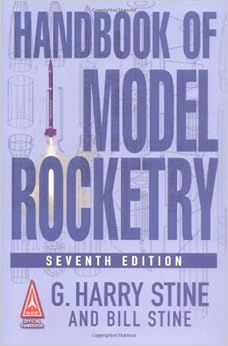
It doesn't stop there, of course. Since it comes from a maker movement publisher, the book gives a lot of details on how you can make all your own ground support equipment - launch controllers, launch pads - as well as tracking devices to find a rocket's altitude, and a lot of technical information about how to determine things like what size parachute you need, what kind of motor you'll want to put in your rocket... It's pretty great, and I found it very helpful - it filled in some of the "how-to" gaps I felt after reading The Handbook of Model Rocketryby G. Harry Stine and Bill Stine.
Required reading and a great book, but it left
me wanting to know more - specifically, how-to.
In the book, Westerfield mentions another, forthcoming book, Make: High Power Rockets, due out "some time in 2015." Having read and re-read Make: Rockets..., I really want to get my hands on this book, because I want to see his take on certain things.
On Friday, I emailed MakerMedia, the book's publisher, to ask if they had an expected publication date. MakerMedia also publishes Make magazine, a publication aimed at the DIY maker's movement with an emphasis on craft, electronics, at-home science and engineering, and they run Maker Faire.
I told them how much I liked the book, and attached a link to my video of Janus I - the two-stage rocket I designed and built myself, just for their interest.
What happened then was most unexpected. I heard back from several enthusiastic people at MakerMedia, including one person from the magazine who asked if they could post my video on their Facebook page. "Of course!" I said. What a cool birthday present!
High power rocketry is a large subject, so the news is that the book will probably be out some time early next year, 2016.
I hope it's sooner, but there's a lot of information to put into a high power book. Not only information - any book from MakerMedia is about making stuff, so there's surely a lot of things to design and try out before it ends up in the book.
The new book will cover both mid power and high power rocketry, as the first book only focused on models that used up to an E sized engine.
The first book gives some elegant designs for low power stuff, so I would like to see Westerfield's take on certain things for mid to high power:
1. Through-the-wall fins (also known as TTW)
This is where fins have a tab at the root, which gets inserted into a slot in the rocket body tube and attached to the motor mount.
The tab at the root of the fin (upper left)...
This goes through a slot in the body tube and is
glued directly to the motor mount tube.
This adds strength, as the fins aren't merely glued to the surface where they can easily snap off at landing.
TTW fins are mentioned in Make: Rockets, but the author says that these are less common to find in low power rockets. They're much more common - in fact, necessary - in mid and high power rockets.
While that's true, I do have a few kits with TTW fins - the Cosmic Explorer, pictured above, and the Crossfire ISX, both low power, Skill Level 1 kits.
Fins for the Crossfire ISX
I'm far less worried about these fins breaking off at landing.
In a kit, the fin slots are usually pre-cut, so you don't have to worry about getting them straight. When you build your own design, you have to cut your own tabs - something I haven't tried yet.
Here's a video from Tim Van Milligan at Apogee Components about slotting your own tubes for TTW fins:
If I had opted for TTW fins for my Janus I, I would probably not have snapped two of them off at home after the first flight.
Perhaps the Tim Van Milligan method is the one everyone uses. But what I like about Westerfield's first book is that he gives lots of explicit instructions and explanations, so I'm looking forward to seeing his take on this in the next book.
2. Launch rail construction
As I mentioned here, I think I want to build a launch rail for my larger rockets. There are a lot of designs out there on the web, but some of them can be hard to decipher for a n00b. What are these parts? How do I "shim" that thing in there? John Coker gives a great design for a launcher base, but I don't know where to get the parts, or how to cut them, or if I need to learn to weld... etc. I'm just not experienced enough at making some things.
In the previous book, Westerfield has a really elegant design for a low power launch pad. It's sturdy, and you can swivel it to any angle, and it uses a drill chuck to hold the rod, so you can put any size rod in it you want, up to a 1/4 inch or more.
I actually went for an easier option for mine - my camera tripod broke, so I can no longer raise the head. So I got the Odd'l Rockets Adeptor, which screws right onto the tripod camera shoe. I made a blast deflector from a steel box cover, and it works great.
The Adeptor from Chris Michielssen at oddlrockets.com...
...transforms a camera tripod into a launch pad. Just add a blast deflector.
My blast deflector is a steel electric box cover with a hole drilled in the middle. I can lay
the lead wires from the launch controller into the slots and hold them still with the
binder clips. This gives some slack to the wires so the initer doesn't pull out.
But Westerfield gives great instructions - and since this is a Maker publication, there is no assumption you know how to work with the parts you need. You get a complete parts list, and instructions on how to cut what where, etc. You can vary the design if you know what you're doing, but if you don't, all the instructions are in there, clearly spelled out.
So I'd like to see his rail launch pad design.
3. Launch relay system
For high power rockets, you need to be far away from the launch pad, for safety. Because of this, you might need very long wires from the launch controller out to the pad. But the longer the wires, the more resistance you have in the system, so by the time the wires reach the pad, there may not be enough current running through them to reliably fire the igniter.
A relay is basically a remote switch hooked up to a battery. The launch controller merely tells the switch to close, while the battery running power to the igniter itself is right there, near the pad. So the igniter gets all the current it needs - the igniter gets the power directly from the relay battery, not from the batteries in the launch controller.
But a relay isn't useful only for high power rockets. It's also useful for cluster rockets - where the rocket has multiple motors side by side.
The Quest Quadrunner - a four-motor cluster rocket
When you have current flowing through multiple igniters, the current through each igniter is less.
The current gets divided up among the igniters. Which means that it can
take a split second longer for each igniter to get hot enough to start
the motor. If, say, two out of three or four motors start before the
others get ignited, and the rocket leaves the pad, the igniters will
fall out the back of the unlit motor(s), and you'll get an uneven or
less powerful flight.
A view of the motor mount during construction. All four motors mustignite simultaneously, or the rocket won't fly right.
Reliable, simultaneous ignition is the main problem with a cluster launch, so having a relay with the battery right by the pad using only a short section of wire makes this less of a problem - each igniter gets as much juice as it can, simultaneously.
Now, just as with launch pads, there are a lot of plans online for relay systems. One guy on The Rocketry Forum even sent me a very detailed schematic for his relay system, and it's clear and understandable. But, I'm not very experienced with electronics - in fact, I've only built one electronics project: the launch controller from Westerfield's previous book, Make: Rockets...
The "Mono Launch Controller" from Make: Rockets..
I'd been wanting to make my own launch controller. In fact, there are lots of plans online - the National Association of Rocketry website has instructions for a very simple one. But I wanted something more versatile. I looked at lots of schematics, and thought of designing my own.
I understood how the controller should work. But, being such a n00b at electronics, I was too nervous to do it. I had no experience building anything electrical, and I thought what if I get the wrong switch or resistor or something, and I don't have enough amps or ohms or watts or whatever??
Again, Westerfield gives a detailed parts list, and explains the hows and whys of launch controllers. Included in the book are tables of the various igniters you find out there, and the minimum amperage needed to ignite them all - including how many of each igniter can reliably be used with his launch controller design. He also gives a detailed, mathematical explanation of resistance and amperage, which you are free to skip if it's over your head - you can merely follow the instructions and build the controller if you want to.
I built this thing, following the very detailed instructions, and it works beautifully.
A phono jack serves as the launch safety key
The lead wires connect to the controller with banana jacks -
you can remove them for easy transport and storage.
The controller has internal batteries, but you can connect a
12v external battery through a cigarette lighter-style jack.
But, of course, it does have a 35 foot lead wire out to the launch pad, and the external 12 volt battery is right by the launch controller.
Perhaps you've heard that one of the best igniters on the market for clusters - the Quest Q2G2 - has been off the market for many months, and will continue to be until they can bring them back. When they do, they are likely to have a different form of pyrogen on them, the substance which flares up to aid motor ignition when the wires get hot enough. They may continue to be great, but they may be slower.
Anyway, for now, I need to use Estes igniters on my cluster rockets, and I want to make sure they light reliably. A relay would be very helpful with this. Given the detailed nature of the previous book, I am eager to read Westerfield's instructions on relay systems.
I'm not into high power yet, but I am about to transition into mid power. There is a lot of information which crosses over, and I like to do my homework before I embark on a new rocketry project. 2016 seems a long time away when I think about rockets, but it's something to look forward to.
There is already a handbook on high power rockets - Modern High Power Rocketry by Mark Canepa. But it is already ten years old. Some things change - including technology and legal issues - and besides, it's always good to have more than one resource for information on a subject. I look forward to seeing what information Mike Westerfield will bring us.