Showing posts with label trident. Show all posts

Monday, May 11, 2015

(A) Little Time for Rockets

I'm in the final week of rehearsals for my final show at the Bloomington Playwrights Project, the theater which is also responsible for me discovering rocketry.

As a result, I've been rather too busy to blog much, so my final post in the mid power Quest Big Dog series will be out in a few more days - maybe a week.

But I'm going to launch on Wednesday - and this time, I'll be lucky enough to launch at a farm! One of my fellow cast members has a huge place, and he's having us over for some rocket time.

This is great news, because this will be the last time Chad will be in town before I move to Boston, so it will be our last launch together here in Bloomington.

So I'll be pulling out all the stops, and launching everything I've got - including the Big Dog, the recently-built Estes Cosmic Explorer with an E motor mount, and the Quest Quad Runner - which I've had ready to go since December, but haven't wanted to risk losing on its maiden flight.

Here are the never-flown additions to the fleet that I will finally be launching:

Estes Cosmic Explorer with a larger motor mount
Quest Big Dog
Sounder I - a small scratch built rocket which will go high and fast
The Ceres B booster, from Mike Westerfields book
Make: Rockets: Down-to-Earth Rocket Science
Trident 1A - a 3-motor cluster, my first ever design
The Quest Quad Runner - a 4-motor cluster
Janus II with a camera payload bay.
This also holds an altimeter.

Aside from these new additions, I'll launch the rest of the current fleet as well. Pictures and video to follow!

Like my Facebook page for blog updates.

Monday, March 23, 2015

Rainy Days - What's a Rocketeer To Do?

It's chilly today, and supposed to rain for the next few days, so I won't be painting anything for a week or so. I'm nearly done with one paint job, but it will have to be put on hold.

So, what else can I work on?

Sounder I

Sounder I is a cute little rocket I designed to go high - 2800 feet on an Estes E9-6 motor. If I add a booster with a D12-0 motor, it could go as high as 3500 feet.

It's not finished, though. This color - Rust-Oleum 2X Marigold - is so pretty, I'm tempted to leave it like this. But a rocket needs some extra detail, and I plan on putting a black roll pattern on the top half of the rocket, stopping at the nose cone.

The first time I tried painting this color on, I got some weird paint problems. There was some discoloration, and worse, the texture was like sandpaper. I don't know how it happened, but I've had this occur two other times in the past - the worst being on my last Cosmic Explorer:

 Ugh!

Chad gave me his rockets when he moved out to upstate New York, and a couple of his rockets had this texture. I thought how on Earth did he do this?? Then it happened to me.

I think it was related to temperature or humidity, or to the fact that I wiped the rocket down with rubbing alcohol just prior to painting. This was to remove dust without using water; primer is porous, and water can damage the rocket. But of course, alcohol evaporates quickly, cooling down the surface of whatever it's rubbed on. Perhaps I painted too quickly after the alcohol, and the difference in temperature between the paint and the surface of the rocket caused this.

The only solution was to wet sand the horrible texture off, which causes you to lose some gloss and some color. In any case, I'm not going to risk this happening again until it's warmer outside.

Sounder I will also be my first rocket which uses micro rail buttons instead of a launch lug. This allows you to launch from a Makerbeam rail instead of a rod - a miniature version of the common high power rocket launch platform. I already have the rail, but haven't mounted it to anything. So I guess I need to go to the hardware store and get some stuff to build the launch pad.

Trident A 3-Motor Cluster

Trident A, my 3-motor cluster design, has a couple of issues.


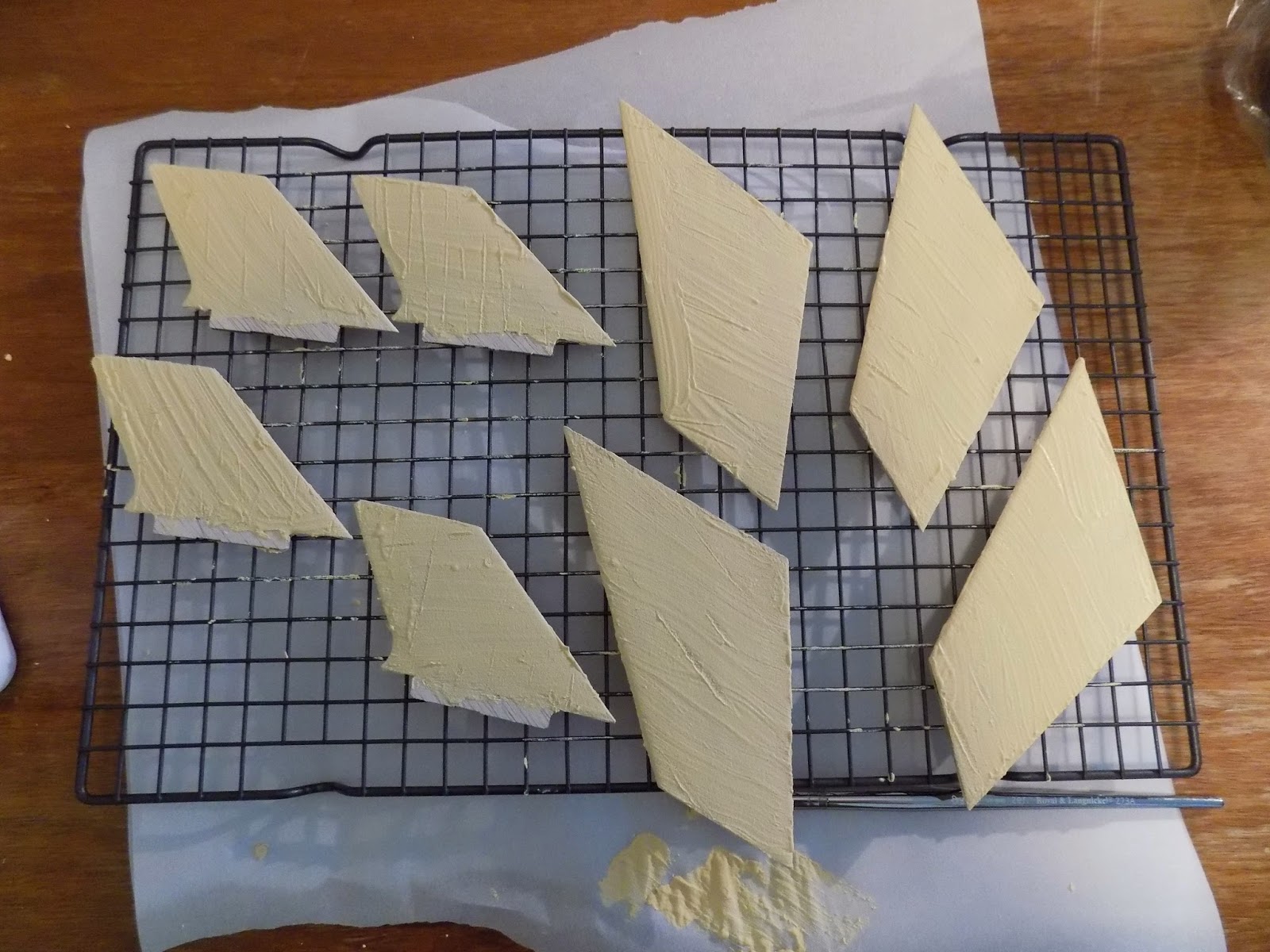
I got a fin on crooked. The fins have tabs on them, which set between the three motor tubes, which are exposed, rather than being hidden inside the rocket. In order to get the fins on right, I had to sand the tabs to a point, which turned out to be trickier than I'd thought. Perhaps that is why I had a fin go on crooked, I'm not sure. But I didn't even notice it until I was painting, when it was suddenly really obvious.

The used motors are in place to keep paint out of the motor tubes.
The open tube is the one that goes onto the painting rig.
And it's a tricky masking job, with the inner tubes being red, the fins (and tabs) being black, and the rest of the rocket being white. I already got some red where I don't want it - on the outer body tube.

And that wasn't even the hard part. The tricky part will be completely covering the red motor tubes and getting black on the fins all the way down to the root.

This rocket may not turn out looking great. But it'll fly, and sometimes a build just doesn't go your way. At least this was my own design, and not an expensive kit.

Ceres B Booster

Ceres B - from the design in Mike Westerfield's book, Make: Rockets: Down-to-Earth Rocket Science, is now at the primer stage. I love the way a rocket looks when it's covered in primer. It looks solid and serious.


Had a bit of a whoopsie with this one, too. I'm using filler primer, in hopes of covering some of the flaws in the fins. Filler primer has a build to it, so it can fill in scratches. I usually mask off the motor tube and hook. In this case, I forgot to do that. I got some primer in the little notch where the hook comes out. The notch is to allow you to pull the hook away from the tube so you can get the motor in. I basically primed that notch closed. I had to clear it out with a hobby knife.


Cosmic Explorer with E Motor

A few months ago, I started a series on this blog about upgrading a kit to a larger motor size (mistakenly calling it a "kit bash"), with the Estes Cosmic Explorer. I abandoned that series, because I built the rocket and forgot to take enough pictures, then I lost the rocket on the first flight.

But what a flight!


The rocket went over three times as high as the standard Cosmic Explorer! So, I'm building it again, and I'll have a series about that. I'll also have a post about sanding your fins into airfoil shapes, which I did for the Explorer:


Other Stuff...

I hope to make some progress on the Quest Big Dog in the next couple of days. And I'm slowly chipping away at an upcoming post about rocket stability, for fellow rocket n00bs. That one is taking me a while, because I want to make sure it's a) accurate, b) easy to understand, and c) not a boring pain to read. But it's an important post for this blog, because I have a future series planned on designing your own rocket - which isn't as hard or intimidating as you may think. I'd go so far as to say that it's easy, at least for your basic rockets. But understanding stability is an important prerequisite.

So, that's what I'm up to. I guess I should stop writing and go work on my rockets - I have a ton of sanding to do...


Like my Facebook page for blog updates.

Friday, February 13, 2015

Rocket Fever! Part II

I lost my voice a few days ago, and was barely able to speak a word for about two or three days. Yesterday, I sounded like Batman. Today, I woke up speaking like the guy from Sling Blade.

This is... an improvement?

Don't worry - I am now on medication. The hardest part about this is that I've been too tired to work on rockets most days.

However... One day last week, I felt a little better, and got a surprising amount done.

I primed the Trident A, my three-motor cluster scratch build. I also sanded the plastic ridges - or flash - and applied plastic putty to the nose cone. Once this is sanded and painted, you won't see the seam.


I sanded the nose cone of the Sounder I - the tiny, super high-flying rocket I designed on a whim a few weeks ago. I just wanted to see how high I could get a little rocket to go by tinkering in OpenRocket. This one will go high and fast, and if I add a booster stage to it, it'll go even higher and faster - up to 3500 feet at Mach .62!


Both Trident A and Sounder I - especially Sounder I - will need added nose weight to be stable in flight. For that, I'll add some clay to the nose - 5 grams in the case of Trident, and more in the case of Sounder.

So I picked up a little scale to measure components - including fins, motor hooks, payloads - and clay for nose weight.

This one is small - too small to weigh an entire rocket. But it's accurate to a tenth of a gram. There were scales accurate to a hundredth of a gram. That might be useful if you were using a simulator to determine potential performance, and wanted extreme accuracy, or if you were doing competition rocketry. But this one was less than $8, including free shipping. So it's good enough for my purposes for the time being.

Next, after reading something on The Rocketry Forum, I decided I wanted to see if I could fill fins with CA (for n00bs, I mean see if I could make the wooden fins smoother by covering them in cyanoacrylate - super glue). I tried this once before on my Estes Hi Flier, but it didn't turn out great. Either I used too little CA, or sanded them too little, or too much, or used the wrong primer.

Extreme closeup of the Hi Flier - not terrible, but you can still see some wood grain.


In any case, some people seem to have good success with this technique, and I get a little tired of using wood filler sometimes - it always takes me at least three coats of filler before I get a finish I like, and that's a lot of drying time and sanding, and half the time I still notice flaws once I start priming and painting the rocket.

I had some fins lying around from a rocket I never finished - the Ceres B booster from the book Make: Rockets: Down-to-Earth Rocket Science by Mike Westerfield.

The Ceres boosters from the book have four fins. Three is easier, and the four-
finned version can be overstable - especially with a heavy payload on top.


I had a problem with my first build on this, and in the end, I decided to make the Janus II two-stage rocket, and stick the payload from the Ceres on top of that.

Anyway, I grabbed a tube and started gluing on fins. I figured if the filling technique worked, I'd just make the rocket. Then I decided why not just make the rocket anyway? I recently lost three rockets, and this will be a nice big one with an E motor. Even if the finish isn't perfect, I'll still have a rocket that should fly well, and look pretty cool.

So I glued on the fins, without even bothering to fill in the body tube spirals - which is something I always do. But I'm going to experiment here. I'm going to fill the fins with CA and prime the rocket with filler primer, and see how good that combination is at covering flaws.

I'm getting better at using the guillotine fin jig.

Then I started playing around with some of the rocket parts I had lying around. I got some potential new ideas just sticking a transition and more tubes on top of the Ceres B.

A transition and a BT50 make for a different look...

Adding the Sounder I on top make it kind of look like a sounding rocket scale model.

Of course, this rocket was designed to carry the ICU2 camera payload bay, seen here.
I included a standoff for the launch lug, so that I can use this payload.
I even thought how easy it would be to stick three tubes on the sides between all the fins - external motor pods! Then I'd have a four-motor cluster rocket, one with a lot of different potential cool looks! As long as you design your rocket so that it's stable, the looks are kind of up to you. The design possibilities are kind of exciting.

Finally, I started one of my big rockets: the Estes Partizon, a Pro Series II rocket, which I got during the Estes holiday sales.


I picked this rocket to do first, I guess, because it was the one I was least excited about, so I wasn't too worried about messing it up.

I can't tell you why I wasn't as excited about it - maybe it's the Estes suggested paint job, a kind of ugly purple and orange I find rather dull. But the thing about building rockets is that you can make them any color and pattern you want.

Of course, once I start building a rocket, I am really consumed by that rocket, and devote lots of care to it. This one is freakishly tall for me - 56 inches! That's only 4 inches shorter than my mother... Now I have to pick a color scheme. I'll post pictures of the build soon.

I haven't blogged in a week, so I wanted to let any regular readers there may be what I've been up to.

I have a couple pieces of exciting news coming up. Stay tuned!

[EDIT] Oh, I nearly forgot! I emailed Estes about the wonky fin on my Nike Smoke, and they got right back to me. They're sending me a new rocket, and I don't even have to send the original rocket back. So, I guess I get to keep that for spare parts.

Good job, Estes!

Like my Facebook page for blog updates.

Friday, February 6, 2015

Rocket Fever

So, I'm under the weather. Thought it might be flu, but perhaps just a bad cold or something. In any case, I've spent hours in bed since Wednesday, when I woke up with a fever, chills and aches.. I thought I wouldn't be able to get any rocket building done in this condition. I don't like to build when I'm excessively tired - it makes me sloppy.

But I had time on my hands, so I chipped away at a couple of projects.

The Trident A cluster rocket is nearly done.

The Trident A has a cluster of three motors, with exposed motor tubes, for awesomeness.


This was the very first rocket I designed, a few months ago. Building it was much easier than I'd thought it would be, and I'm sorry to say that I really didn't take any pictures of the process. I thought this would be a rocket I could easily mess up, but it hasn't been bad at all.

Masking and painting, thought... That might be tough. This might call for an airbrush. Here's the color scheme I'm thinking of:

The airframe is white, the motor tubes inside that are red, and the fins - with tabs - are black. I'm not
sure how I'm going to get these colors where they need to be and nowhere else!
I wanted to start building yet another Cosmic Explorer with an E motor mount after losing my previous one, but I realized I didn't have enough centering rings. I'd buy them from JonRocket.com, but in order to justify the shipping, I like to buy a bunch of stuff at once.

I also received some Quest Q2G2 initiators in the mail!


For n00bs, let me explain the significance of these.

Q2G2's are igniters for black powder motors, just like the ones that come with your Estes motors. But they're made differently. For one thing, they're insulated, so they won't short out at the launch pad. More importantly, they are low-current igniters, which means they take less electric current to get them to fire. In fact, an Estes launch controller can't be used with them, because they'd fire as soon as you put in the safety key. Why would you want that?

Because the Q2G2 requires less current to fire, they light up almost instantaneously, which is very important when launching a cluster rocket - you want all the motors to ignite simultaneously, or the rocket will take off with only some of its motors firing.

But most significant of all is that these have been off the market for months! Possibly since I first got into rocketry, possibly longer.

All I know is that I seemed to have just missed the boat on these, and just when I really started getting excited by the idea of cluster rockets. To date, I've only done one cluster launch - my Quest Magnum Sport Loader, launched with Estes igniters. That was fine - it's only a two-motor rocket. But reliable ignition is the biggest issue with clusters, and the more motors you have, the more igniters, the trickier it gets. I'm so glad I have these!

BTW: I got these from BuyRocketMotors.com, a site to bookmark. They specialize in high power motors, so if you're new, you won't need them for a little while. But you'd be surprised how quickly people go from Skill Level 1 Estes kits to high power rocketry.

I accessed it by going first to brm.therocketryshow.com. The Rocketry Show is a podcast you should check out - whether you're a beginner or not - run by a couple of guys from Ohio. It's still pretty new, but promises to cover a lot of aspects of hobby rocketry - from low power model rockets to high power. If, like me, you're both a podcast junkie and obsessed with rockets, it's the perfect combo.


Anyway, if you get your motors through brm.therocketryshow.com, part of your purchase will help support The Rocketry Show.

I also got some more rockets in the mail today. I know - I have way too many. But my parents had given me a $50 gift card to Estes for my birthday. I'd just bought a ton of Estes rockets. I really wasn't sure what I'd use it on.


Then, Estes had a repeat of its holiday sale. Since I'd lost the Cosmic Explorer, I got another one of those (I need backups, guys!), plus a long two-stage rocket called the Air Commander. I'd turned my nose up at that one during the holidays, for whatever reason. I decided this time to just get it.

I had to spend $49.99 for free shipping. I nearly bought the 4-rocket PSII bundle again, just so I'd have plenty of them to potentially screw up building or lose in flight, but I went a different route. I got one that was not on sale - really, I wanted the free shipping. I ended up getting something I'd had my eye on for a while - the Nike Smoke, a 1:5.5 scale model of a NASA sounding rocket.


It's a nice-sized rocket with a nose cone that's nearly the length of the airframe.

I also picked up a replacement parachute for Der Red Max. That chute has taken quite a beating.

Since the Nike Smoke has plastic fins which are pre-beveled, it should take me a lot less time to build. I cannot stop myself from shaping the fins at least a little to improve aerodynamics, and I can't keep myself from filling the wood grain on wooden fins. This makes my builds take more time than they might.

I was about set to start building the Nike Smoke right away, when I noticed that one of the plastic fins was deformed.

The lower corner of this fin is round. It's supposed to be pointed. This is a molding error.
I emailed Estes to find out what to do about this, but it was late on a Friday. So I assume I won't hear anything until Monday. Bummer. I'd like to start this rocket. But I guess I'll have to wait.

Well, hopefully I'll feel better soon. My fever seems to be gone. And I've got to go back to work. Plus I'm directing a show at the Bloomington Playwrights Project, so that's going to take up some time and energy.

Sunday, February 1, 2015

Launched Three, Lost Three

My fleet has grown smaller.

On Wednesday, Chad and another friend - Jeff - and I launched some rockets. It was going to be either Wednesday or Thursday, but the weather looked bad on Thursday, so we had a small launch window.

Unfortunately, while the winds seemed light, they were stronger than I thought, especially at altitude.

This was my first loss. Losing rockets is an inevitable hazard of rocketry, but this was my first, and man, was it a bummer!

But I learned a couple things on this launch. The first is Check your Go Fever. If the winds look bad, you don't have to launch.

The second is that Chad is a terrible videographer. The footage of the launches is terrible. If my girlfriend had been in town, I'd have some spectacular footage to show you. Fortunately, Jeff got some good pictures.

Chad, as I've reported here before, has lost most of his rockets, and I think he was secretly happy this happened to me. I was actually glad he was there to witness it, so he'd stop whining "Oh, I'm Daniel, and I never lose rockets!"

I'd brought all my bigger rockets, including a few I'd never launched before. Once I noticed it was a little windy, though, I had to make a decision what I was going to try to launch. I was not about to go with the Quest Quadrunner, after all the trouble I'd gone through building it. And replacing it would cost me nearly fifty bucks.

The first loss was the most painful. It was the just-built Cosmic Explorer with an E motor upgrade.

On the left: my original Cosmic Explorer which can only hold up to a C motor.
On the right: the just-completed Cosmic Explorer with an E-sized motor mount -
capable of going three times as high


I knew this was a risk, with a bit of wind. But I'd gotten one of the fins on slightly crooked, and had a little problem with the paint job. And I have two more of them I can build, so I said "screw it! Let's launch this sucker!"

 
The first thing that happened was that my launch controller wasn't working. I gave it a little shake, and heard some rattling around inside. "That doesn't sound good," Jeff said. I'm not the best at soldering... Fortunately, I had my Estes launch controllers with me. No way to do a cluster launch with that, but I was nervous about those rockets anyway.

The flight was amazing. About 1800 feet or more, straight up. That E9 black powder motor made a huge sound (E is all I've gotten up to at this point, so I'm still impressed by it), lots of smoke, and the thing just soared.


But then, there was no tracking smoke, and after a moment, we lost sight of the rocket completely!

Then, for a second, we caught sight of the parachute. It was so high up and so tiny that I thought it hadn't opened all the way. But it had. 1800 feet might be a low guestimate, and I'm basing it on my OpenRocket simulation. The Cosmic Explorer has a big red parachute, and it was so far away.

After a second, I lost sight of it again. We kept searching the skies for it, and it just vanished. It had headed northwest, but that's all I knew. If it had crashed to the ground, or gotten stuck in a tree, I'd have been sad about that, but the fact that it simply disappeared was... I don't know. I just wanted to know where it had gone.

Sarcasm: Chad reaches out with eyes closed to catch the rocket as it falls straight down...

OK, I knew launching the Cosmic Explorer might be a bad idea. But I decided to keep going. Go Fever.

Next I put the 3D Rocketry Nautilus II on the pad.


This, I thought, would be fine. We have a large flying field, the Nautilus II is fatter and only takes a D motor, and it has a smaller parachute. Besides, it had suffered some major fin damage on its first flight, so I decided to press on with it.

Again, the flight was awesome. Much straighter than the first time I'd launched it, and very high - though not out of sight.


As soon as the chute opened, I thought, oh, no... It's going to go over the trees at the end of the field!

Chad ran to see if he could catch the rocket, which he likes to do. He's like a labrador retriever, and we just can't keep him off the couch...

Then, instead of going over the trees, the Nautilus II landed in the tops of them.

"Rocket-eating trees" are a commonly mentioned hazard in rocketry, and Chad is the Charlie Brown of rockets, but this was my first loss to the trees. And this is a good, open field, so it's not a huge risk here, but it happened.

The only trees to worry about are at the north end of the field.
 Chad ran to see if he could recover the rocket. There it was, tantalizingly dangling from the very end of a thin, outer branch. If the wind changed direction, it might have fallen right out, but the wind was holding the rocket securely on the branch.

I decided to try one last thing. I had the Estes Athena in the bottom of the box. This is a ready-to-fly model I got for $7. I thought If I can get this back, maybe I'll continue launching. If not, I didn't build it, so I won't be sad about it. I tilted the pad slightly into the wind, so that it would fly less high, but possibly come back and land on the field.


All rockets turn somewhat into the wind. For n00bs, this is referred to as "weathercocking." It happens whether you want it to or not. But you can take advantage of it - you can tilt into the wind, and have the rocket return closed to the launch area, or tilt it slightly with the wind, and the rocket will straighten up as it weathercocks, and achieve a higher altitude than it would if launched straight up in windy conditions.


It did weathercock into the wind, and I had hope of getting it back. But the chute opened, and we saw it streak across the sky - the wind must have picked up a lot! It moved so fast, it was like watching Sputnik cross the night sky. It flew over the trees at the end of the field, right over Chad's head, and disappeared.

Chad and Jeff had to leave, and I spent the next hour and a half hiking corn fields looking for the Cosmic Explorer. It had traveled northwest, so I felt I had a good chance of recovering it.

I walked up the hill to the trees and saw the Nautilus II dangling from the branch. I had to cross some train tracks and find a way through the thick brush to the corn field. I walked the whole thing, and up into some grass and woods. Eventually, I realized I shouldn't spend a lot of time hiking around on someone's property, so I hiked back.

I kept thinking I saw it, but it kept turning out to be broken corn stalks gleaming in the falling sun. In any case, I never saw that red chute flutter in the breeze.


Obviously, nothing is green there right now...

I realized that thing could have gone for a mile or two! Or it could have landed somewhere where I couldn't get to or just didn't notice.

I drove around the area, trying to see if I could spot it in an open patch of land. Nothing...

It was only after searching for the Cosmic Explorer that I realized how bummed out I was to lose it. I only got to launch it once, I thought. You can launch any rocket once. The trick is launching it more than once.

I drove back the next day, hopeful that a change in the wind had knocked the Nautilus II from the branch it hung from. Instead, it had become more tangled, and on this day it twisted in the breeze. Today, it's raining pretty hard, so even if it eventually comes down, it will probably be ruined.


So, I lost a few rockets.

But when I got home that night, I started fiddling around with OpenRocket. Out of curiosity, I wanted to see how quickly I could design a little rocket for altitude and speed, using just an E motor and parts I already had. In about twenty minutes, I came up with a design that should top 2600 feet and go Mach .58, or 3500 feet at Mach .61 if I add a D motor booster. I called it Sounder I (for now), and I may lose it, but it was easy and cheap, and it's kind of an experiment. I'm mostly interested in building larger rockets, but I wanted to play around with a simple, high performance design.


I started building it the next day.

Sounder I sustainer, nearly done. I built this in an evening.
I also started building the first scratch design I came up with months ago, a 3-motor cluster called the Trident A.


The Trident A motor mount, part of which will be exposed to view
So, I'm replenishing the fleet.

Like my Facebook page for blog updates.