Showing posts with label kit. Show all posts

Wednesday, November 5, 2014

Building the Big Bertha - Part 8 (For N00bs)

[Click here for Part 1]

Now that your Skill Level 1 rocket is painted (and completely dry), it's time to finish building it - then you get to fly the thing!

If you've been following my posts here, you may get the impression that these things take forever to build. Actually, you can complete a Skill Level 1 rocket in a day or two - sometimes in as little as just a few hours (most of that is waiting for glue to dry). But I wanted to give you the details on how I build a rocket. I approach even easy rockets with care, so mine sometimes do take weeks, but that's only because I'm fussy and want a really nice end product. If you skip all the extras and just follow the instructions in the kit, you'll be done rather quickly, something you should probably do for your first rocket, so you don't get frustrated and quit before you see how awesome this hobby is.

OK, let's finish this baby up by adding the recovery system - this is how we get the rocket back safe and sound to fly again. All we have to do is attach the shock cord and parachute, and we're done!

First, we're going to attach the shock cord - that's often a long, flat, rubber band-looking thing (or sometimes a thick, yellow Kevlar thread). We'll assume you're probably doing an Estes kit, like the Big Bertha, because that's what most people do. So, the rubber bandy thing.

Your instruction sheet will have an elongated trapezoidal shape divided into three numbered sections. That is the shock cord mount - you'll have to cut that out with scissors. Fold the two sides inward along the fold lines, so they'll crease easily when you glue the shock cord in.


Put a dot of wood glue in the middle area, and place one end of the shock cord in it, with the other end running out through the fat end. Fold the skinny end of the shock cord mount over the center part and press it so the glue spreads throughout it. Hold that in place a moment until the glue starts to set.


Next, place some glue onto the fat end of the shock cord mount where the cord itself is trailing out, and fold the middle/skinny ends over that. Press until excess glue squishes out the sides, and hold that until the glue starts to set.

Now you'll have a long shock cord secured into a tiny trapezoid of paper. Allow this to dry a little bit (I've moved too quickly here and the whole thing came apart because the glue hadn't properly set), but you don't need it to dry completely to move on.

You now have what's sometimes called a "tea bag mount," because if you hold the shock cord with the mount hanging down, it kind of looks like a tea bag.

This finished mount is smaller - because it's from the Estes Star Trooper - a tiny rocket. Again, I got
engrossed in finishing the Big Bertha and neglected to photograph the finished shock cord mount.
But it looks the same, aside from the size.

The final step here is to place some glue into the body tube. Get a good dab of glue on the pad of your finger and spread it in one squarish spot on the inside of the body tube, about 1 1/2 to 2 inches from the top - no less. You need to make sure the shock cord mount is far enough into the rocket body to keep it from touching the nose cone when you insert it, or the cord might get in the way, and you won't get the nose cone on, because the fat shock cord won't leave enough space!

Wipe the excess glue off your fingers and place the shock cord mount down onto the glue, with the side the shock cord comes out facing the opening at the top of the rocket. Press this down and rub it around a little to make sure the glue spreads evenly and thinly under the paper shock cord mount. Hold it there a few moments until the glue begins to set, then let go.


Set the rocket on its side and allow the glue to dry for at least probably 20-30 minutes. Then, for good measure, use your finger to apply a thin layer of wood glue over the top of the shock cord mount to make sure you've got it good and sealed to the inside of the rocket.

Boom. Shock cord is now done. With the other end, you'll tie it to the loop of plastic in the base of the nose cone. Tie it well - a buntline hitch works, or just a simple double knot - and then you might put a dab of glue onto the knot to keep it in place.

Tying a buntline hitch

Let the shock cord mount and the nose cone glue (if you used it) dry completely, with the rocket lying on its side, and the nose cone lying separately - don't put the nose cone into the rocket at this point, or you might glue it on permanently, and you don't want that!


Once the glue is dry, it's time to attach the parachute. Probably the majority of basic kits use a parachute for recovery. Smaller rockets might use a simple streamer - a ribbon of plastic or paper which slows the rocket's descent enough that it won't be damaged. The streamer is pretty simple; you just tape one end of it to the shock cord. Other rockets might use some other form of recovery - tumble recovery, say, where the rocket comes apart and is so light it just falls to the ground in two pieces, and doesn't tend to get damaged.

But let's assume you have a parachute for now, like the Big Bertha has.

Skill Level 1 kits come with the parachute already assembled - you get a hexagonal chute with three shroud lines, each line attached to two corners of the chute.

The easy way to attach it to the nose cone is to hold the three lines together, form a little loop at the end, and thread this through the same loop of plastic in the nose cone to which you attached the shock cord. Pull the loop through, open it up with the shroud lines halfway through. Then you're going to pull the chute tight and pass it through the big loop and pull that tight - the chute will be attached to the nose cone.

This parachute is tied directly to the nose cone - you can see how the shroud lines get tangled after a few flights.

However, you might want to be able to remove the parachute between flights, and if you tie the chute right to the nose, you won't really be able to do that. It will quickly become tangled, and you won't get it untied. Parachute lines become tangled in ways that almost seem impossible to me. The lines are attached to the chute at one end and the nose cone at another, and yet, sometimes, I look at a parachute after a flight and ask How did those lines get tangled?? They crossed over each other! What is this sorcery??


Also, it's good for the chute to be stored separately from a rocket, hanging upside down, like from a pin in a cork board. The chute will be less likely to become permanently folded, so you're less likely to have it fail to open. A good way to attach a parachute is with a snap swivel. You get these where you find fishing equipment.

I love this aspect of rocketry - you find useful tools and materials where you wouldn't expect them to be, and you hack or adapt them to your purposes.

Just attach the chute to the closed loop of the snap swivel like you would to the nose cone, and when you want to attach everything to the nose cone, you just open the snap swivel and attach that to the nose cone.


All you do now is fold up your parachute, stuff it and the shock cord into the body of the rocket, and put the nose cone on top.

There are a number of ways to fold the parachute - some better than others. The instructions for the Estes kits aren't great - when I fold a chute like that for flying, they fail to open about half the time.
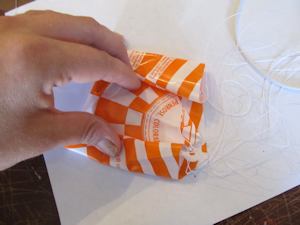
Estes has you fold the top of the chute over and roll the sides in - not
ideal for launching, as they don't open half the time (in my experience).

We'll discuss parachute folding - with pictures - when we talk about launching. For now, you can roll the chute up like it says in the kit instructions.

Put the nose cone on, and look at your handiwork:

The completed Estes Big Bertha rocket - tall and beautiful!

YOU HAVE FINISHED YOUR ROCKET!

I hope any rocket n00bs out there have gotten some useful information from this Skill Level 1 tutorial series. This is just the beginning. There are a lot of cool tools and techniques, more advanced kits, higher skill levels, more powerful rocketry options and cool add-ons for rockets (payloads, multistage boosters, etc.). We'll get to all these on this blog, I hope. For now, build yourself a kit, fly it, and see if you like it. If you do, build a few more kits. When you get confident with your skills as a basic rocket builder, you're ready for something more challenging.

I've been doing this for only a little over three months now, and I've learned so much. There's a lot of fun stuff to do in rocketry, and things that seem way too complicated when you first start out are actually achievable. If you develop a passion for this, like I have, you can advance your skills and do things that will surprise you.

Take it slow. It's not a race. Have fun.

But here's a preview of something you might not yet think you can do - I certainly didn't when I started. This is a rocket I designed and built myself - and it's a two-stage rocket on top of that! I'll make a post soon about designing and building your own - something very satisfying, and not as complicated as you might think - it just takes a little time, the right tools, and some thought.

For now, though, here's a video of the first launch of my first "scratch-built" rocket, Janus I - named for the two-faced Roman god of beginnings and change. I hope you enjoy.


Friday, October 10, 2014

Building the Big Bertha - Part 5 (For N00bs)

[Click here for Part 1]

In Part 4, the first thing we did was to reinforce the ends of the body tube with a bit of thin CA - cyanoacrylate, or super glue. Turns out, this is a really good idea.

A couple days ago, I took a few rockets out to try out my new homemade launch controller.


I took my newly-completed Big Bertha with me. Since it was a little windy, and I didn't want to lose my beautiful, new rocket to a big gust of wind, I put in the weakest motor I had - an A8-3 (We'll talk about motors later, but I'll just say, the A is the least powerful of the standard sized motors). This was a mistake, because it turns out this motor is far too weak for a rocket this heavy (always read the instructions!).

The controller works great. But the rocket lifted off the launch rod, went about 50 feet maximum into the air, then the motor ceased its burn and the rocket took a nose dive straight at the Earth. The ejection charge blew the nose cone off about 6 feet from the ground. The parachute didn't even open, and the rocket body embedded itself into the ground.

The parachute is still folded...

This could have been the end of the Big Bertha. But I pulled it out of the ground. Smoke still oozed out of the top of the tube. Apart from a bit of mud, grass and clover leaves, there was no damage!


So that Rocket Pro Tip was well worth it!

OK, back to our build. Now it's time to add the fins to the rocket body.

The first thing we need to do is determine where the fins will go, and mark the tube, so that we get them on straight. Kits come with a fin marking guide for this purpose.


You'll cut this out and wrap it around the body tube, somewhere near the base. Make sure the lines on the ends line up perfectly - that's how you know you have the fin marking guide on straight.

You can see here that my fin marking guide has a bit
of a gap in it. Some Estes kits are a bit sloppy on a few
details. But the fin lines did line up perfectly.
The lines marked FL are fin lines - put a pencil (NEVER a marker or pen) mark on the body tube where they indicate. The LL line is for the launch lug - mark this as well. In the above photo, I had it off-center a bit while manipulating the camera. Often, the launch lug and the engine hook are lined up.

Next, what you'll need to do is draw a perfectly straight line up the body tube to show exactly where to place the fins. Well, how do you do that?

The traditional way is to place the body tube in a door jamb and use that as a straight rule to mark a line up the tube. People have been doing that since the birth of model rocketry in the 1960's, and it works. Many kits will explicitly include that in the instructions. If that's all you've got, it's fine. But it has drawbacks.

Some door jambs are not as straight as they should be - especially in an older house that has settled, or been repainted many times. And they may have chips in them. And you'll get pencil lines on your door jambs.

Using a door jamb to mark a fin line -
notice the nick in the jamb?
 There's a better option.

You can make yourself a really cool, cheap tool, with aluminum angle. This is a piece of aluminum, sold at hardware stores, and it's used for... I dunno. Construction or something. Doors or windows. I have no idea. I only know it's used for rockets.

It comes in 3-foot lengths, and it costs less than two bucks. Get yourself a piece of 1/2 inch aluminum angle, the kind with equal-length sides, and cut off an 8- to 12-inch piece with a hack saw. Here's mine:

I even put 1-inch marks on the side with a Sharpie so I could use it as a crude measuring tool. I wasn't sure that would come in handy, but it has. Not as precise as a ruler, but it's nice to have some times.

See how the angle sits exactly along the tube?

Line the angle (or the door jamb, or the Estes Tube Marking Guide) up with the fin marks you made, and draw a line up the body tube, for several inches. Then do the launch lug line. I like to mark the launch lug line with an LL so I don't accidentally glue a fin to the wrong place.

The yellow thing is an Estes Tube Marking Guide part.
See? Perfect lines!


Now it's time to glue on the fins. This gave me a real panic the first time I did it. I knew I would have to do this freehand, and I was pretty sure I would screw it up.

There are options for assuring that you get perfectly straight fins. But if this is your first rocket, try it freehand. It's not as hard as you think - you'll just have to hold the fins in place until the glue sets.

For low power rockets, most people use either wood glue - sometimes called "yellow glue," because it's yellowish - or "white glue" like Elmer's Glue All, so called because it's white. Some people use epoxy, but that's more for higher powered rockets, so for your first Skill Level 1 kit, just get some yellow or white glue. Do not use "school glue" or anything washable - it just won't hold as well.

Wood glue, white glue. I started with the Elmer's wood glue,
but I've really taken a liking to this Titebond stuff.

You can make the glue set better and in less time by creating a double glue joint. This works really well with wood glue, which is about all I use, because it creates a stronger bond - stronger than the material it's gluing, so the rocket itself will break before the glue does.

First thing to do is to put a small bit of glue on the root edge of the fin. Just dab a bit on the root edge, then spread it up the edge with a finger, so there's a thin layer of glue all along the edge. Then locate the place on the rocket where the base of the fin will sit - it's often, but not always, lined up with the base of the body tube (your kit's instructions will tell you where to put the fins - you may need to mark a spot on the body tube where they'll go). Put the fin exactly where you'll glue it down, pressing the glue to the body tube. Then remove the fin.

Yep. Remove it. We're going to let the glue on the fin edge and the body tube dry a bit. Then we'll re-glue it, and the "double glue joint" will set a lot faster, and be a lot stronger. Set the fin somewhere where the glued edge won't touch anything, and let the glue dry for a few minutes.

When I built my first rocket, the idea of getting the fins on straight was the part that made me hesitate. But I did pretty well with it. I did have to keep my hands on the rocket, and keep checking that I wasn't moving the fins, but I'm happy with the rocket.

But there are tools you can use. If you read Harry Stine's Handbook of Model Rocketry, you will find instructions for making a very simple fin jig, called a Kuhn fin jig. This is just a piece of wooden angle - used for doors or something - with a slot cut right in the center.

Works great - if you have the power tools to make it, and know how to get the slot cut exactly perpendicular to the angle, and get it the right thickness for your fins - none of which do I have or know how to do.

The Estes Tube Marking Guide has a Kuhn-style fin jig at the end, which is helpful - sometimes. I've used mine on a few rockets, but I discovered quickly that if the fins are too thick, they'll barely fit, and if you're building a smaller rocket with more than three fins, it won't work at all...

Building the Estes Mini Honest John. With the Estes Tube Marking Guide
fin jig, I can get opposite fins on, but not the
two side fins. Those, I had to do by hand.
Still, it has helped me get my fins on straight on some of my favorite rockets.

I recently invested in the coolest tool in my toolbox - the Guillotine Fin Jig, created by a guy named Ted Macklin, and sold by Apogee Components. Now, if you're just getting into rockets, and not sure how involved you're going to be, you might want to hold off on a lot of special tools. The Guillotine Fin Jig is not cheap - it's about $90. But it is so ingenious. It holds your rocket in place and holds your fins perfectly straight. So, if you're building your first rocket or so, do it by hand. But if you've decided that you really want to make more, better rockets, getting a fin jig like the Guillotine is a really nice investment.

It's also great for carrying stuff from one room to the other, if you tighten down all the nuts, because the body of it is basically a wooden box.

Back to gluing on fins! Once your glue has set for a few minutes, apply another thin layer of glue to the fin root edge, and carefully line the fin up with the fin line you marked on the body tube, and hold it - or jig it - in place. Let it set for a few minutes at least before you do anything. I leave mine in the fin jig for at least 20 minutes or so and get a snack or work on some other rocketry project.


There may be small gaps due to imperfections in the tube, or imperfect
sanding - this is fine. Press the fin to the tube tightly for a moment and
let the double glue joint do its work. We'll fill in any minor gaps later.
Perfectly aligned fin. This is why I love good tools. You need skill to make a nice
rocket, but a good tool can help you make a better rocket, with less of a struggle.
Repeat the process for all your fins.


Now the fins are on, and your rocket is starting to actually look like a friggin' rocket!

Next time, we'll apply glue fillets to the fins to reinforce them (and make them more aerodynamic), attach the launch lug, and maybe even prime this sucker and start painting! Stay tuned...

[Click here for Part 6]

Tuesday, October 7, 2014

Building the Big Bertha - Part 4 (For N00bs)

[Click here for Part 1]

Once you're happy with the smooth texture of your fins, it's time to set them aside for now, and focus on the body tube, with a couple of Rocket Pro Tips.

I got some of these tips from various places online, including Chris Michielssen's Model Rocket Building blog.

First thing I always do, even though it is not written in the instructions, is to reinforce the ends of the body tube. To do this, I use cyanoacrylate - commonly called CA. This is the same stuff as Super Glue, but you can find specially made bottles at hobby shops which come in different viscosities.  This stuff is useful for a lot of rocketry applications (though not generally recommended for gluing on fins or motor mounts).

For this, you want thin CA, which is pretty watery. This stuff bonds instantly to skin, as I learned when I glued a bit of paper towel to my finger, so you'll need to be careful. With thin CA, you should also wear eye protection.

Protective eye gear, thin CA (pink bottle) and CA un-bonder,
in case you glue your fingers together

Open the bottle of CA and run a very thin bead of the glue around the inside of very ends of the tube. Using a bit of paper towel, wipe off any excess - though don't use your fingers. Roll up a bit of it into a kind of wand or baton, hold it from one end, and run the other end lightly around the inside of the tube. Throw the paper towel away immediately, so you don't accidentally grab it by the wet part later and end up with stuck fingers.

Thin CA will wick into the paper fibers, and when it dries, the ends of the tube will be stronger and harder - good if your rocket has a hard landing.


It also makes it less likely the end of the tube will wear out from having the nose cone inserted and removed launch after launch.

Now, these low power rockets are all made with tubes of rolled paper - cardboard, essentially, a little like what you find at the center of a roll of paper towels or toilet paper, but better constructed, a bit thicker, and usually with some kind of waxy, smooth coating on them.

But they do all have that spiral groove winding their way from one end to another. That groove will show up through the paint job, so when people look closely at your rocket, they can tell. "Oh, yeah, looks like a paper towel tube." But you can fix that, and hide that groove, so that people may not be able to tell what it's made of.

Before I go any further, let me say that you can totally skip this next step if you're not into it. A lot of people build tons of rockets and don't bother. I didn't even know it was an option when I built my first rocket, Der Red Max, and I was really happy with the way that turned out - though now I can see the spiral.

A visible tube spiral on Der Red Max. Spirals are sometimes hard to see on a bare
body tube, but they're really visible once you prime and paint the rocket.

 But a lot of people prefer it, and I try to do it with every rocket I make.

There are a few options for filling a tube spiral (technically, it's a helix), but by far the most common solution is to use more of the carpenter's wood filler - CWF - we used to fill the wood grain in the fins. This doesn't take nearly as much time as the fins did, and if you get it right, the results are rewarding.

I admit, I've had trouble getting this right, and it's only with this latest build, the Big Bertha, that I finally did it to my satisfaction. More about that in a minute. The other option, which I've read about but not tried yet, is to skip the filling, and when you go to prime the rocket for painting, use automotive filler primer instead of mere sandable primer. Filler primer is used to fill in deep scratches in car paint jobs, so it actually has some structure, and you can sand it smooth, filling in the seam as you go through the priming process.


When I heard about this, it sounded much easier, but I'm stubborn, and wanted to learn the CWF technique, so I kept at it.

You'll need some CWF - thinned, but perhaps not as much as you used to paint onto the fins - and a razor blade. You'll also need something to apply the CWF to the spiral seams. Chris Michielssen of the Model Rocket Building blog uses the tip of a used (dulled) hobby knife to apply CWF right to the seams, and he's a real pro at getting rockets to look great. But I've tried this, and I personally don't have a lot of success with it. So I use a fine tipped artist's paintbrush. You'll want a fresh razor blade. You might also want a freshly-sharpened pencil.

There are actually two seams. One of them is easier to see than the other, especially on white tubes (they're usually white or brown, and they're a little different, but I don't know enough to tell you what the technical difference is). Often, that one is actually filled in - the seam is on the inside, and you're seeing the filled outside of it, so it looks darker. Run your thumbnail around the tube until you feel the other seam - it may be invisible. That's the one you're going to fill, because that is the one you'll see when you paint the rocket.

Run the tip of the pencil down the whole length of the seam, from the top of the tube to the bottom. Now you can clearly see the seam, and you'll be able to get CWF exactly where you need it.

Next, apply the CWF to the seam, going about an inch or so at a time at most. Use Chris Michielssen's knife blade technique if that works for you, or paint it on. I try to tap it into the seam with the tip of the paint brush, then brush over that, so I get CWF all the way into the seam.


Next, grab your razor blade, and scrape off all the excess. You're going to hold the razor so it is lined up with the body tube, perfectly straight, and so the blade is perpendicular to the surface of the tube. Be careful not to cut into the tube - you're just using this blade as a super fine putty knife to push the putty into the seam, and scrape off all the excess, so you'll have less sanding to do later.

Don't hold it at an angle like this - this was just me trying to use one
hand to hold the blade, and the other to take a picture.

 Wipe the edge of the blade off often, on the edge of the container of CWF. Go inch by inch, all the length of the tube. When you're done, you should have a fully-filled spiral, with not much excess to sand off.


Once the CWF on the tube is dry, you're going to sand it off. Now, this is supposed to be really easy, but I admit for the first few rockets I built, every time I tried sanding the CWF down to the surface, I ended up scuffing the waxy coating on the tube and ended up raising all of these hairy paper fibers from the tube. I could not for the life of me stop doing this, and it ended up making my rockets have some weird fuzzies on them.

Paper fuzzy bits poking through the finish of my Crossfire ISX. This
was driving me absolutely crazy for my first few builds!
When I asked about this on The Rocketry Forum, I got a lot of responses, ranging from "You need to sand in little circles" (I did) to "Did you use a sanding block?" (sometimes yes, sometimes no, always with the same result) to "I don't bother to do that on tiny paper rockets" or even "Why bother? Nobody's going to notice when it's rotting in a tree!"

What nobody ever said was "Yeah, I used to have that same problem myself. Here's how I solved it..."

I tried fine grit sanding paper, rougher grit sanding paper, wet sanding (bad idea with no paint on it), dry sanding, etc. So, I was beginning to think that this whole CWF spiral filling thing was either beyond me, or that maybe it was some kind of rocket urban legend, and that the secret was something the real craftsmen weren't sharing with the rest of us. It was really frustrating me, and I felt like it was holding me back, because regardless of the size of the rocket or the fact that it might end up in a tree or a pond, I wanted to craft a nice rocket. So I kept experimenting.

Then I cracked it.

I now use a sanding sponge. It's like sandpaper, but in sponge form, and it comes in various grits. The finest I could find was 320. This is why it is important - for me - to use the razor blade method and get as much of the excess CWF off the rocket body before I sand, because I want to sand as little as possible. Something about the sponge being softer and conforming to the body of the rocket makes it less likely that I raise those nasty paper fibers, and I end up with an acceptable surface for painting later.

My sanding sponge, just before sanding off the CWF. You can rinse these
out, and they last a lot longer than a piece of sandpaper.


Chris Michielssen - whom I've mentioned on this blog numerous times, and I recommend you check his blog out if you want to see some expert builds - sands CWF off seams by going parallel to the body tube, thereby going across the CWF. I have to be really careful, so I lightly sand with a corner of the sponge in tiny circles, trying to touch only the CWF. I go slowly, and stop if it looks like I'm going too far.

You might just try using sandpaper - I've seen some people using grit as coarse as 150 or even 100. Maybe it's just me.

Anyway, when you're done, there should be no raised bits of CWF, and when you prime your rocket, those spiral seams will be invisible.

Now, I had said in Part 3 that we'd put the fins on in this post, but this body tube prep post has gotten longer than I'd anticipated, so I'll save that for Part 5. We'll figure out where the fins go, attach them to the rocket, and I'll show you a cool, very useful tool that you can make yourself for less than two bucks.

Click here for Part 5


Saturday, October 4, 2014

Building the Big Bertha - Part 3 (For N00bs)

[Click here for Part 1]

Now that your fins have dried, it's time to sand them smooth.

They'll be pretty rough when you start. The CWF will have formed ridges and clumps, and you need to knock all that off before you get to the finer sanding.

A fin from my Crossfire ISX - again, I neglected to take
pictures of the Big Bertha fins here. See how rough the
fin looks? You need to sand off those brush marks.
Use a sanding block (this can be a scrap of wood with sandpaper wrapped tightly around it) and a rougher grit of sandpaper - say, 220. Sand in little circles until most of the brush marks are nearly gone, then switch to a finer grit of paper - 320 or 400. Continue sanding in little circles.

Now, when I started doing this, I assumed you sand until all the CWF is gone, and the balsa grain would be filled. CWF is good, but not that good. If you sand off all the CWF, you're going to see wood grain in your paint job. So, what you want to do is sand most of the wood filler off and leave just a thin layer or skin of it.

You'll likely expose a bit of wood. This is fine for now. Just go slowly and be careful. I find that the edges of the fins have exposed wood while the center is still coated in CWF. This is probably due to either a very slight warp in the fins, or not having the sandpaper tightly enough against the sanding block, or possibly pressing too hard toward the outside. Either way, it's kind of unavoidable sometimes. We're going to repeat this process, so don't sweat it.

Sand the edges carefully, finding that rounded edge without overdoing it and sanding any of the wood off. Sand the root edge if you have any CWF on it, and make sure it's flat. I stand my fins on the root edge to make sure they're square.

Blow away any dust from the sanding so you can see what you're doing. When you're done, most of the fins will be incredibly smooth - with some imperfections...


As I was doing my initial sanding, I accidentally gouged one side of the fin. I was sanding on a piece of newspaper that had some bits of stuff underneath, and pressing down made these indentations. Also, you might be able to see at the edge some exposed wood.

Gouges are what CWF was made for. I needed to recoat the fins anyway, so I made sure to use a putty knife to really push the CWF into the indentations. Do another coat of CWF, let dry, and sand again. Then do it again. About three coats should really do it, unless you get lucky with your second coat. You can thin the CWF out a little bit more on your third coat, so you use less and have less to sand off.

When you're satisfied, you're done. Wipe off any dust from the fins with a slightly damp paper towel, and dry them immediately. Set the fins aside for now.

Now, let's turn to the motor mount, or engine mount. In most rocket kits, this is a short tube which is narrower than the body of the rocket, and is held in place with a couple of rings of cardboard or round paper, called centering rings. Some rockets have no mount, as the body is the same size as the motor used, so the motor goes right into the body of the rocket. This is called a minimum-diameter rocket, as the rocket is no fatter than it needs to be to accommodate the motor. This is what you use for rockets that go high and fast, as the weight is kept to a minimum.

The Estes Hi Flier is a minimum-diameter rocket. The
body tube is the motor mount! That stand is actually
a standard motor - just the right size to fit the body.
 The Big Bertha, however, is a large, slow lifting rocket, which I like, because it doesn't disappear into the sky in a second.

The motor mount usually also has a metal hook attached to it, called an engine hook. This keeps the motor in the rocket. Inside the motor mount, you also usually have something called an engine block or thrust ring. This is just a ring of paper which keeps the motor from shooting out through the top of the rocket, destroying everything in its path.

Motor mount parts - 1) Motor tube 2) Centering rings 3) Engine hook
4) Mylar hook sleeve 5) Engine block/thrust ring

 A lot of motor mounts are built the same way. The instructions with your kit will give the proper measurements, but there's not much variation. First, you mark where the engine hook and centering rings will go. Then you cut a tiny slit for the end of the hook - this is in the fore end or top of the mount, maybe a half inch from the front end. Insert the hook, then slide the little Mylar ring over the hook and glue it in place about halfway down the length of the hook. Put some glue inside the tube just above the little tab of the engine hook and glue the engine block in place - if it's not right inside the tube, you can use a motor to push it into place, or some kits come with a cardboard tube for this purpose.

These marks, from top to bottom, are where
the engine hook will be inserted, where the
hook sleeve will go, and where the aft centering
ring will be glued. I tend to mark the fore
and aft ends of the motor tube so as not to
make a dumb mistake.


1/8 inch slit for the motor hook
Mylar hook sleeve glued in place. Don't glue
down the aft end of the hook - you need it
to bend to insert a motor!


 One centering ring has a notch in it. This is to give the hook a little flex room. That goes at the base or aft of the mount. The other ring goes at the top or fore, and butts up against the part of the engine hook sticking out of the motor tube.


These have to be well-glued. Make sure they'll fit before you glue them, sanding them a bit if they're too tight. Then apply a liberal amount of wood glue around the tube where they'll go and slide them into place. There should be enough glue to make a fillet - extra glue at the joint - to reinforce the bond.

Engine mount finished, waiting for glue to dry. You can
see the engine hook, the centering rings, the Mylar
hook sleeve, and glue fillets at the joints. The engine
block/thrust ring is inside, toward the base in this photo.
That's it. The motor mount is finished. Once it's dry, you can glue it into the base of the rocket.

Apply a good amount of wood glue about 1 1/2 - 2 inches into the base of the rocket. You need a ring of it, and you want to be kind of liberal with it. First, you want to push the glue into place, and you want it to form a reinforcing fillet of glue when it comes to rest. Second, if you use too little glue, the glue can seize up, and the motor mount can get stuck only halfway into the rocket!

You can apply the glue with a small dowel rod or craft (popsicle) stick, but I have gotten to where I just use my fingers. I can feel that I've gotten enough glue in, and I'm less likely to get glue where I don't want it if I go by feel rather than using a stick.

Push the motor mount halfway in, and apply some more glue about a quarter inch inside the base of the rocket. Push the motor mount into place, with the motor tube either flush with the base of the body tube, or with about a quarter inch of overhang (depending on your kit's instructions).

Installing a motor mount - in this case, in my Cosmic Explorer. Again, I didn't
photograph this part of the Big Bertha build...
Dribble a little wood glue between the motor tube and the body tube to get a good fillet between the aft centering ring and the body of the rocket. Use a thin dowel rod or coffee stir stick to smooth a nice fillet joint between these to parts all the way around.

Stand the rocket body tube on the fore or top end and allow all the glue to dry for at least a couple hours. I leave it overnight.

In the next post, we'll actually have (gasp!) pictures of the Big Bertha build. And we'll learn some Rocket Pro Tips on getting a good surface for painting. We're getting closer to finishing this thing!

[Click here for Part 4]