I'm in the final week of rehearsals for my final show at the Bloomington Playwrights Project, the theater which is also responsible for me discovering rocketry.
As a result, I've been rather too busy to blog much, so my final post in the mid power Quest Big Dog series will be out in a few more days - maybe a week.
But I'm going to launch on Wednesday - and this time, I'll be lucky enough to launch at a farm! One of my fellow cast members has a huge place, and he's having us over for some rocket time.
This is great news, because this will be the last time Chad will be in town before I move to Boston, so it will be our last launch together here in Bloomington.
So I'll be pulling out all the stops, and launching everything I've got - including the Big Dog, the recently-built Estes Cosmic Explorer with an E motor mount, and the Quest Quad Runner - which I've had ready to go since December, but haven't wanted to risk losing on its maiden flight.
Here are the never-flown additions to the fleet that I will finally be launching:
Estes Cosmic Explorer with a larger motor mount
Quest Big Dog
Sounder I - a small scratch built rocket which will go high and fast
The Ceres B booster, from Mike Westerfields book Make: Rockets: Down-to-Earth Rocket Science
Trident 1A - a 3-motor cluster, my first ever design
The Quest Quad Runner - a 4-motor cluster
Janus II with a camera payload bay.
This also holds an altimeter.
Aside from these new additions, I'll launch the rest of the current fleet as well. Pictures and video to follow!
Most decals for rocket kits come in one of two types: waterslide decals and self-stick decals. You can also get custom decals made of vinyl or other materials, but for your basic kits, waterslide and self-adhesive are what you will see.
Waterslide decals usually come on a slick backing paper, and appear to be stuck in place. You cut the decals out one by one, and place the whole thing - backing and all - in a bowl of water. In a few minutes, the decal becomes loose, and you literally slide the decal off the backing and onto the rocket. The adhesive soaks up the water and becomes slippery, and for a minute or so you are able to slide the decal around in place until you're happy with it, then pat it dry with a paper towel.
The advantage of waterslide decals is that they are thinner, so they look more like they're a part of the actual paint job of the rocket.
The waterslide decals on the Quest Magnum Sport Loader really look like part of the paint job.
When well applied, they're unlikely to peel off. And they can be treated with various products so that they shrink into any crevices you may have to place them on (such as on a model airplane), so that they really look like a part of the model itself. Another advantage is that they are repositionable for a few minutes while wet, so if you don't get the decals perfectly placed on the rocket the first time, you are able to carefully slide it around until you're happy with it. If you finish the rocket with a coat of clear spray paint, you won't see any edges at all, and it looks great.
The main disadvantage is that they're apt to tear if you're not careful, and if the decal happens to fold over and stick to itself while you're handling it, it's probably ruined.
A waterslide decal on my Estes Cosmic Explorer. I tore this in a couple places, and though
I was able to slide the pieces mostly together, there were some bits that were ruined.
Self-stick decals are basically stickers. They go on, and they stick there. They're not terribly repositionable, but there is a trick you can use to get around that. They're thicker, and you can usually tell they're stickers - you can really see the edges.
The self-adhesive stickers on my Estes Crossfire ISX. You can clearly see the raised edges of the stickers, and my feet.
I really prefer waterslide decals, but there are some great kits which use self-adhesives, and the Big Dog is one of them. The main decal is one that wraps completely around the airframe, extends about nine inches down the body tube, and it's what gives the rocket its character.
I was nervous about getting the large decal on straight, so I put it off a few days. Not a bad idea, anyway, to let your paint cure fully before applying anything sticky to it. If I'd gotten the decal on crooked, it would have looked lopsided - one side of the decal should be flush with the very end of the body tube, so I had to make sure I got it on just right.
I wanted to check the decal to make sure it was the right size for the rocket - if you read my earlier posts, you know that some of the dimensions of the Big Dog don't add up - the centering rings were loose, and the fin marking guide was too short, because while the kit is in fact 1.97 inches in diameter, the box says it's 1.92 inches. I figured there'd be a gap in the decal - not a big deal, since it would be on the back side of the rocket, facing the launch rod - but I wanted to be sure.
So I took a piece of paper and used it to measure the width of the decal, then I wrapped the paper around the body tube. The mark on the left is where the paper met up - the actual circumference of the rocket. The mark on the right is the right-hand edge of the width of the decal.
The decal is too wide! This means that if I put it on the rocket as-is, the decal would overlap itself.
I'm so glad I checked! I could have dealt with a gap, but I did not want the decal to overlap - overlapping could lead to peeling. I decided that trimming the decal was my only option.
I laid the decal down on my cutting mat and taped it into place.
I used the same piece of paper with which I'd measured the circumference of the rocket to make two pencil marks on the decal, telling me how much I needed to trim off. Then I lined those marks up with the back side of a metal ruler (to get a nice, straight cut), and taped the ruler in place - I did not want the ruler to slide around on the plastic decal while I was trimming it. I needed precision here!
Then, with a very sharp, brand new hobby knife blade, I slowly and carefully trimmed off the excess.
Most rocket kits are well-designed, but you do find some flaws now and again. It never hurts to check if you're unsure about a certain part or kit, and make some adjustments. Once you've built a few rocket kits, you'll know where you can safely stray from the instructions, and where you may need to make some changes for appearance, or even safety and functionality.
* * *
I'm going to digress here for a moment, because I think it's important to know, especially if you're a fellow rocket n00b. Building kits, reading about how model rockets work, and building that knowledge base can sometimes help you avert disaster. On another Quest kit - the Quad Runner - I decided this was really necessary for the kit to work properly.
You see, the centering rings which hold the motor tube in place have two functions. The first, of course, is to keep the motor in line with the center of the rocket. But centering rings also create a seal on the aft end of the rocket.
When the rocket motor has used up all its propellant, there is a second charge - the delay grain - which burns slowly without producing any thrust, to allow the rocket to slow down before the parachute deploys. Finally, there is a third charge - the ejection charge - which creates a small explosion coming out the top of the motor, forcing hot gasses into the rocket body tube.
This pressurizes the inside of the rocket, forcing the nose cone to pop out and allowing the parachute to deploy so the rocket can land safely.
If your centering rings were full of holes, say, or there were some kind of gap between the motor tube and the airframe, some of that ejection gas would escape out the back. Meaning the airframe would not pressurize properly. If enough ejection gas leaked out quickly enough, that could mean that there would not be enough internal pressure inside the rocket to eject the nose cone. No ejection, no parachute. And since rockets are designed to fly nose cone first, the rocket would then take a nose dive at the Earth at incredible speed and hit the ground hard and fast, completely destroying the rocket. That seal at the back is very important.
With the motor in place and the centering rings properly glued in, the
only place for ejection gasses to go is up inside the rocket airframe.
The Quad Runner is a four-motor cluster rocket, so it has four motor tubes side by side, and because of that, its centering rings are different. They have clover-shaped cutouts to hold the four motors.
On the left and right, the centering rings for the Quest Quad Runner 4-motor cluster mount
This means that running down the center of the cluster of tubes is a diamond-shaped gap. To fill that gap and block ejection gasses from escaping, an additional, diamond-shaped piece is added to the motor mount.
This piece goes in the gap between the tubes. It also holds the shock
cord, and uses a wing nut to keep the motors in place
But I realized there was a problem. There was a little space between the tubes themselves - they were spaced slightly apart. And by looking at the measurements of the kit instructions, and actually peaking between the motor tubes themselves, I realized that the centering rings did not line up with the little diamond-shaped pieces in the middle of the motor mount.
This mean that ejection gas could travel down the center of the motor mount, between the motor tubes, get around the diamond-shaped piece in the middle, then escape out the back of the rocket between the motor tubes.
Now, it's quite possible that the gaps here are small enough that not enough ejection gas would escape out the back, and the rocket would be fine.
But what if I had a nose cone that was a little snug? What if one or more of the motors didn't ignite, and there were fewer ejection charges going off? I wasn't going to take the risk of one of my more expensive kits taking a ballistic nose dive to oblivion.
So, despite it's not being in the instructions, I decided the best solution was to fill in the gaps between the motor tubes themselves. I simply added a bead of glue to create a fillet.
Glue fillets between the motor tubes themselves sealed off any leaks
This sealed the gaps I was worried about, and would better ensure a successful recovery of the rocket.
The point is, the more you know about rockets, the better able you are to recognize those few times when a kit manufacturer has made a design error - or when you yourself have made a building error - and to correct for those problems.
* * *
Back to the decals!
In order to get the decal straight, I needed some kind of guide or reference. With a piece of aluminum angle, I drew a pencil guide line straight up the back side of the rocket, starting with the hole for the forward rail button.
Self-stick decals will usually get permanently stuck wherever you lay them down, so if you place them incorrectly, you can't adjust them.
Estes Silver Arrow with a crooked self-stick decal
But there's a trick you can use to get around this. Take a small bowl of water and add a little dish soap - a drop or two - and stir to dissolve. Before you stick the decal onto the rocket, dip the decal into the water. It will still stick to the rocket, but if you get it on crooked, you can peel it off without damaging the paint or the decal.
The large wraparound decal is too large for a small bowl, so I used a large metal mixing bowl and added a full squeeze of dish soap. To make sure I'd gotten the ratio right, I first applied the small decals that went on the fins. I figured if I weren't able to peel these off, they'd still be relatively straight, and it wouldn't be crucial. I could add more dish soap to the water before doing the large wraparound.
But I was able to peel and re-stick the fin decals, so it was a go.
I was pretty sure I would be unable to get the wraparound decal on straight by myself. So I asked my girlfriend to hold the rocket for me. She held the rocket parallel to the ground, with the guide line on the back side facing me. I dipped the large decal into the soapy water, then lined one edge of it up with the guide line, making sure the end of the decal matched up with the end of the airframe. Then, slowly, she rotated the rocket while I pressed the decal into place, squeezing out air bubbles and pulling the decal taught to keep it straight. I had to peel and replace the decal a couple of times, but eventually, it went on straight.
If there's a better, easier, or more accurate way to apply a wraparound decal, please let us know in the comments section!
After applying the rest of the decals myself, I popped the nose cone on to have a look at the nearly-finished rocket.
The Dupli-Color Cardinal Red paint I selected was not a good match for the decal - the Rust-Oleum Apple Red paint would have been much closer. This was my first time using lacquer paint, so I can't be sure, but I think the red paint on the nose cone darkened a little as it cured.
This was when I discovered that I had already bought an extra can of Rust-Oleum Apple Red specifically for the Big Dog.
Now I have a ton of red - guess I need to build some more rockets!
Now, I'm pretty picky, so I do have to admit that this color mismatch does bother me. But other than that, and considering all the things that could have gone wrong on this build, not bad!
The rocket is nearly finished - just a few more details before it's ready to fly.
The last few weeks were exhausting, with me directing a show at the Bloomington Playwrights Project. This will be my last year directing this show, a fundraiser called The Blizzard (it's a bunch of short comedies done in random order), so Chad (Artistic Director) and my other friend David (in his role as Associate Artistic Director) got me this great thank-you gift:
It's a watch which tells you what constellations are in the sky, and where, depending on the time of year and your location on the Earth. It's pretty great - it's both space-related and time-related (the show was on a 60-minute timer), and now I'm going to have to start wearing a watch.
The show was a hit, and now it's over, and I finally caught up on sleep. Now it's time to get back to rockets!
Bit by bit, I've finished building my first mid power rocket, the Estes Partizon, one of the Pro Series II rockets.
A lot of firsts for me on this rocket. First time using epoxy instead of wood glue, first 29mm motor mount, first screw-on motor retainer, first use of rail buttons...
Mini buttons, actually. For use with a metric rail. I got these from rail-buttons.com.
Now that the thing is built, it struck me - I have no idea how I'm going to paint this thing! It's nearly 5 feet tall, so I can't just stick a rolled up newspaper in the back to hold it while I paint. I'm going to have to build something to hold it.
Oh, I also need to build a new launch pad with a rail. I've got the rail. Now the hard part begins - assembling a launch pad to hold it.
I've sanded a few rockets I'd been chipping away at, and then moved right on to assembling the motor mount for the Quest Big Dog.
This is another 29mm motor mount rocket, and again, I'll install a screw-on motor retainer, but it's much smaller than the Partizon. Much closer in size to the Quad Runner.
So, painting shouldn't be a problem. I've been wanting to get this rocket built for some time, but I've been procrastinating, because I wanted to get the fins perfect. I find that the cycle of filling fins with CWF, then sanding, then filling, then sanding... It gets tiring. One coat never works for me - I can still always see imperfections and wood grain. And sanding all the pock marks out is hard.
If you've read my Skill Level 1 series, you know that I press my fins between sheets of parchment paper to let them dry. This is so they won't warp. You're supposed to be able to paint both sides of the fins evenly with CWF and let them air dry, and they're not supposed to warp, but this never works for me - they always warp a little. So, I press them.
But that makes little pock marks and ripples in the CWF that are hard to sand out smoothly. I end up having to do multiple coats.
I've attempted papering my fins, but that has yet to go well - either I tear the paper or I get weird clumps of glue under it, so it's really no better for me than CWF. It just goes faster.
What I really need to do now is make some decisions regarding the rocketry class I'll be teaching this summer. Biggest decisions include what kit to build, how many different projects to undertake in one week (it's 3 hours 10 minutes a day for five days, so I need to have enough to do to fill the whole class), what is safe enough for 11-14 year old kids to handle (hobby knife? Spray paint? Probably no to both of these), and how to make it informative while keeping it fun.
I might go for the Estes Alpha bulk pack, a beginner's classic rocket.
I want balsa fins - rockets with premade plastic fin cans are too quick to assemble. I don't want to be finished building the rockets on Monday and have nothing left for the rest of the week.
We'll probably round the edges on the fins, assemble the rockets, and I think we'll build launch pads, too. We'll talk a little about science, maybe a little about rocket stability, and even look at design - if I can get to all that in one week. Then we'll have the big launch.
I'm pushing for a launch at the Fairgrounds. Then I can have a grand finale with some bigger rockets - give the kids something to strive for.
All rockets are prepped and loaded, and all cameras and altimeter are charged and ready. All I have to do now is shower, load up the car, and get out there.
I've nearly completed the three rockets I've been working on for a month and a half, just in time for tomorrow's Epic Rocket Launch. Just a bit of paint here, a few stickers there, and a couple knots tied, and we'll be All Systems Go.
Janus II with camera payload bay, Quest Quadrunner 4-motor cluster rocket, and 3D Rocketry's Nautilus II, the first kit I ever purchased which wasn't from Estes (which is where most of us start)
All that's needed now is a few details.
The Janus II - which is the big brother of my first ever designed-and-built (or "scratch built") rocket Janus I - will get a touch of black on the fin tips.
Looking at this rocket, with the gray body and fat payload section, it kind of reminds me of a shark - which gave me an idea for a new design I'm going to play with (but which in the end may be unstable and therefore unflyable) called the Hammerhead. Mostly I like names for rockets that don't try too hard to sound "badass," but I might make an exception in this case. Stay tuned.
Here are the two Janus models side by side for comparison.
Janus I and Janus II. Janus I uses standard 18mm (A-C) rocket motors, while Janus II is designed for 24mm motors - one D and one E. Both are two-stage rockets.
Even without a special payload section, you can see that Janus II is taller than Janus I - this is because since it's made to take larger (and heavier) motors, which sit in the aft end, the rocket needs to be either longer or weighted in the nose in order to be stable without using oversized fins. This has to do with the relationship between the center of gravity and center of pressure, and if you're new to rockets, we'll get to that in another post on the basics of rocket stability.
Also notice that Janus I has four fins on the booster and main body (sustainer) of the rocket, while Janus II has only 3. This reduces drag and increases altitude (and makes building faster - less sanding and fewer fin fillets to apply). My simulation estimates that Janus II will top 1700 feet.
But just to check, I also have an altimeter.
Altimeter Two, from Jolly Logic
This tiny little guy will tell me what the peak altitude reached is, and a number of other flight data points - such as top speed, maximum acceleration up to 23 Gs (!!), altitude at parachute ejection and the velocity at which it descends (with that parachute). It's can go up to 29,500 feet, so I think it'll do the trick.
Here's the camera seated in the Janus II payload bay:
Peekaboo!
So, this rocket will carry two payloads - the camera and the altimeter - it has enough room for both, plus an egg if I wanted to do that (though I'd like to spare my new altimeter the potential humiliation).
The Quadrunner is in pretty good shape, considering the ordeal I blogged about a few days ago. It's not perfect, but once the decals are on, the little flaws may not be noticeable.
The Quest Quadrunner - tall, powerful, beautiful...
With four C6 motors, this should easily top 2000 feet, although I may add a bit of weight just to slow it down a bit. Four motors can lift a lot of weight. This rocket is not that heavy - and in a recent Youtube video I saw of a launch, the thing took off so fast the camera couldn't keep up. After a month and a half of work, I'd prefer to minimize the risk of my losing this rocket on its maiden voyage.
The Nautilus II by 3D Rocketry will get copper fins and perhaps nose cone, although I'm tempted to leave it this flat black color. It looks imposing like this.
But I got the copper paint, so I feel like I should go through with it. I hope I don't regret that decision! The rocket flies on a D motor, and should go pretty high.
We're also going to attempt to launch Chad's Aspire rocket from Apogee Components. This thing is supposed to top one mile in altitude. Last time we launched, I must have inserted the igniter wrong (it's a composite motor, not black powder, and I'm not used to those yet), because it flashed, and nothing happened. Such a disappointing end! I have four spare igniters for this rocket, so we'll try our best. We'll probably never see it again...
I was going to hold back on a few of my smaller rockets, but I realized, hey, this is the last launch of the year! I should go all out! So I'm launching everything I've got - everything I've built, that is. My pre-made, ready-to-fly models will probably stay at home, or I'll launch one first to check the wind direction and speed.
But here's nearly everything I built myself since I started doing this less than six months ago - the fleet for tomorrow's launch:
Back row: Janus II, Cosmic Explorer (Estes), Nautilus II (3D Rocketry), Aspire (Apogee Components), Magnum Sport Loader (Quest Aerospace), Big Bertha (Estes), Quadrunner (Quest Aerospace). Middle row: High Flier (Estes), Crossfire ISX (Estes), Der Red Max (Estes). Front row: Star Trooper (Estes), Mini Honest John (Estes)
Janus I is retired, due to damage, but everything else I've built is going into the sky tomorrow, and I hope to have pictures and video to share - including POV video from the nose of the Janus II!
The weather looks good, so we shouldn't have to scrub the launch like we did Saturday. Honestly, I was glad for a few more days to finish these three rockets, but now it's Go Time.
I've been putting together a video compilation for a few weeks of all my launches - or, at least, all the ones that came out OK, and after tomorrow, I'm going to put a Slo-Mo Supercut on my Youtube channel. Rocket porn, basically. Now that I'm building bigger rockets, I hope to get some good video. Small rockets are really impressive to watch in person - they go so high so fast! But on video, it's hard to convey the exciting nature of the launch. Bigger rockets look better on video.
If I stick with this (I plan on it), I think I'll try to make it an annual tradition of putting out a slo-mo launch supercut of the year on January 1. I've got some bigger rockets to build, so hopefully years to come will see some good video - and who knows, maybe a Level 1 high power rocket certification launch??
I tend to write really long posts, and this is no exception. But, if you're new to rockets, I hope you find something of value here to use in your rocket builds. If you're more experienced, I hope you at least find this amusing.
I'm finishing up one of my three latest builds - the Quadrunner, by Quest Aerospace. This is a cool-looking rocket, and has a cluster of four motors - that's a lot of thrust, fire, noise and smoke compared to what I've launched in the past.
Check out what the kit looks like:
I'd been eyeballing this rocket for some time. I loved the idea of clusters, even before I'd tried them out. My first was the Quest Magnum Sport Loader, which was a lot of fun. Even with only two motors, you get a much more dramatic launch than with a single motor.
Here's the video of the Magnum launching on two Estes C motors - slo-mo at the end:
The Quadrunner is a little pricier than the standard basic kits I'd built in the past - about $45. I got it for less, thanks to an Amazon gift card. But I was nervous about building this rocket. It's more complicated than a Skill Level 1 rocket, and I really wanted to make it look good. It has, of course, the cluster of four motors, which means that putting together the motor mount is more complex, and needs to be more precise than a single-motor mount. You need all four motors to be perfectly aligned.
The finished mount
This means measuring and gluing precisely, and then rolling the whole thing across the table to make sure it's not wobbly.
There's another part that goes in the middle - it holds the bolt in place you see in the above photograph, which will hold the motors in - this is in place of the usual hooks most beginner's models use.
This meant threading the bolt through two diamond shaped bits, attaching a Kevlar shock cord to the top, then pulling the whole thing through the middle of the four motor tubes - then gluing that in place.
This little bit keeps the motor retention system in place, and is key to assuring your parachute ejects. And it's a tight fit.
It requires some precise sanding to make it fit, and without a precise fit, the ejection gasses from the motors will escape out the back of the rocket. The nose cone won't come off, the parachute won't eject, and the whole thing will come crashing down to earth and destroy all your work.
Then there are the fins. They're two-part fins which you have to glue together to make one piece - something I was nervous about, as I was pretty sure it would be easy to get them crooked.
How on EARTH was I going to get these perfectly straight? And how was I to round the leading edges, with that
joint right there?? This was an area I really could have screwed up this build and made a shabby-looking rocket.
The joint here needed to be pretty close to perfect.
I thought of several options, since in the directions you're meant to lay them flat on waxed paper to glue them together flat. I thought no way that's gonna come out straight - it's gonna dry crooked! I finally emailed Chris Michielssen of the Model Rocket Building blog, to ask what he'd do if he built this rocket. I hadn't found any references to the build on his blog, but I knew that if anybody knew what to do, it would be him.
He gave me some advice - turns out he had built this rocket. He said that gluing them flat on waxed paper was a good idea, and then putting a book on top would keep things straight. I sanded a rounded edge on part of the fins, then beveled the trailing edges, and put them together.
So far, so good.
I took all the steps I've learned so far to make the rocket look (and fly) great - carefully filled in those spiral grooves in the paper body tube, filled and sanded and filled and sanded and filled and sanded the fins, attached the fins to the body as carefully and precisely as I could...
Ted Macklin's guillotine fin jig...
Totally worth the money I paid for it.
Hi, Ted!
I got the fins down perfectly, with no gaps between them and the body tube. Made the best glue fillets I'd ever done - I mean, guys, this thing was looking really solid. Carefully filled the seam in the nose cone with some plastic putty, then refilled when I saw a little divot in the putty. Got the thing as smooth as possible.
Was I going to let this little flaw in the nose cone go unfilled? Oh, no I was not!
Up to this point, I was really proud of what I'd done. I had to take it slow, but I hadn't made any major errors I was bothered with.
Then, I had to wait to do the painting. Or, so I thought.
It's been cold here in Bloomington, and my understanding was that you should never spray paint if it's below 50 degrees Fahrenheit. So I waited.
Then, on a warmer day, I primed the rocket. I used a new primer to me - Rustoleum Sandable Primer. I always use primer that's "sandable," but had never used "Sandable Primer."
Actually, this was my first mistake. It turned out fine, and I really liked the primer. But I had intended to use Rustoleum Filler Primer. This stuff has a "build" to it, and apparently it can fill in flaws in your work. I believe it's used to fill in gouges in a car's paint job. I had a few spots I wanted filled on the fins, and a few weeks ago when shopping, I had been looking at both the Sandable and the Filler Primers. I thought I got the Filler stuff. I realized only after priming the rocket that I'd gone home with the Sandable stuff.
Never mind - it worked great. A few minor flaws that perhaps could have been fixed with the Filler stuff, but after some rigorous sanding, it still looked pretty good.
Warmer than it looks - time to prime
Primed and sanded, ready for painting
Round about this time, I got a suggestion on The Rocketry Forum that you can, in fact, paint when it's cold outside. You warm the paint can with some warm water, run outside with the warm paint and rocket, do a light coat of paint, and bring everything inside to dry and warm up for a few minutes between coats.
I had a launch scheduled for Saturday (cancelled, in the end, due to rain), and I thought I'd have time to finish this rocket by then. I always like having something new to launch each time, because I don't have any other rocketeers to fly with - I launch with friends who are only interested because I try to make it fun for them. Basically, every launch I do is a kind of "demonstration launch," and I'm secretly trying to get one of my friends interested enough to start building and launching, so I have someone to talk rockets with.
I wiped the rocket down with rubbing alcohol to rid it of any dust, and did my undercoats of white. The rocket looked great. No problems due to cold weather - a nice, smooth, shiny finish.
It's hard to light a white rocket indoors, but you get the idea.
After letting the white cure for two days, I was ready to paint the red top coat.
This is where the trouble started...
Now, I was going to include this paint job in a post for my fellow rocket n00bs on the fact that you need to plan certain parts of your build, particularly painting, to avoid a messy job, and to keep from being frustrated. In the process, I learned that I have a lot to learn about certain materials with rocket building...
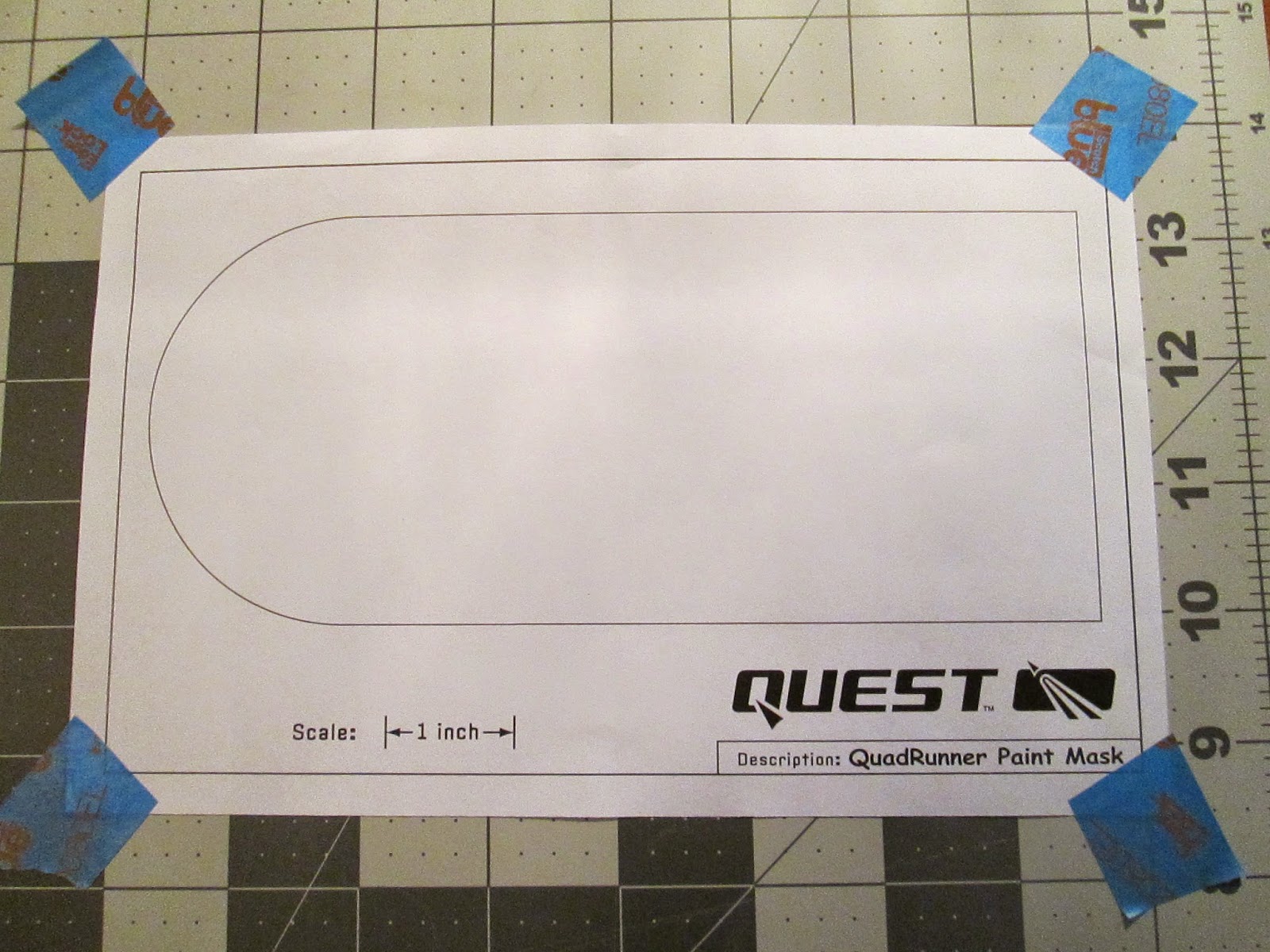
OK, so the Quadrunner comes with a paper mask for painting.
You're supposed to cut this out and apply it to the rocket, with the round half at the top, 1 5/8" from the top of the body tube, then extend the side lines of the mask down to the base of the rocket with masking tape. Then you mask off that whole section with tape and paper, spray the rocket red, and when you're done, you should have a beautiful half-red, half-white rocket with a nice round part near the top of the white side.
This presented a challenge. How could I be sure to get the mask centered and straight? If I applied it the correct distance from the top, how could I be sure that the part of the round top I started with was even the true center of that bit?
Well, I thought about it a bit, and came up with what I think was a pretty good plan, and I thought this is perfect blog material, too! What a smart guy I am!
First, I measured the bottom of the mask, finding the center of that line. Then, using a right angle, I drew from that point up the center of the mask, through the top.
To check my work, I did a little geometry to find the center of the semicircular top - and you can see was off by just a little bit. I made sure the line was straight up the center from the bottom to the top, and carefully cut out the mask.
I cut up the sides with my hobby knife and a metal ruler. I tried to rig up a tool to do the top round cut precisely, using my high school compass and my hobby knife. I think I found this idea in an old Estes or Centuri rocket design publication I found online.
This didn't work as planned, so I just carefully cut the top out with scissors. Not to worry - the black and gold stickers would probably cover any minor imperfections in the shape.
Then I found the centerline between two fins by measuring the distance between the leading edges of the fins and making a mark with a pencil. Then I drew a line all the way from there to the top of the body tube, and on that line, I put a mark 1 5/8" from the top.
Now I had a line on the rocket, and a line on the body tube. If I could get those lines to match up with the top of the mask at that little 1 5/8" mark, I knew I'd have the mask centered and placed correctly, and we'd be good to go.
See? This should work great!
I still think this is a good idea, despite what came next...
To apply the mask, temporary spray adhesive is called for. I have some Elmer's Craft Spray Adhesive, which is either temporary or permanent, depending on how you apply it.
I applied the adhesive to the back of the mask, waited three to five minutes for it to be less tacky, then applied it to the rocket. Success! I got it on perfectly!!
Then I built a beautiful, elaborate mask. It fully covered everything, yet would be easy to remove when I was done painting. I was feeling pretty good up to this point. Why was I so worried about this rocket? Now all I had to do was paint - this would be a cinch!
Doesn't look like everything's covered, because the edges are Scotch tape. But this was
a masking masterpiece, guys. Perfectly aligned edges, full coverage... Great work.
Then came The Ordeal.
To seal the edges, I did a quick pass of the white paint first. Then, to my horror, the edges lifted away from the rocket and began to curl up. Gahh!!! Stop it! Stop it!!
There was no way around it - I'd have to stop my work, remove all the masking, and start again the next day.
I carefully peeled everything off, and laid the paper mask flat. It was a little wrinkled, but the edges were mostly fine, so when it was dry, I laid a book on top of it to flatten it out and left it overnight.
I figured I hadn't used enough of the spray adhesive. So the next day, as soon as I got home from work, I started again. This time, I made sure to get plenty of adhesive on all the edges, and reapplied the mask. Then I built up the whole brown-paper-and-tape masking apparatus and started again.
Here's where I grew impatient. I skipped the white sealing coat (not best practices, but not what led to disaster), and went straight for the red. And what a red! Rust-Oleum 2X Apple Red - bright, shiny, smooth... This rocket was looking beautiful.
I waited for about ten minutes, then began removing the mask. I pulled off the tape and the paper, and the fins were a brilliant white. The line was clean and neat. I pulled off everything but the paper mask... and then the mask wouldn't come off!
I used fingernails and lots of swearing, but the thing wouldn't budge. I even tried to gently, carefully slide the tip of my hobby knife underneath the mask to loosen it. Nothing!!
I went from happy to pretty desperate very quickly. What should I use? Water? Goo Gone? Razor blades?? After several more attempts to just coax the thing off, I'd scratched through in a few spots to primer, and in a couple tiny places down to the white body tube, and I worried I'd even gone through the glassine coating to the fibers below.
A lot of people suggested water (until I mentioned breaking through the tube - then it became too risky), WD-40, white vinegar. Problem with all of these is that the paint had made the paper pretty impenetrable.
Finally, in frustration, I got out a sheet of 220-grit wet/dry sandpaper and went to town on this rocket. Probably a terrible idea, I thought, but at this point, I don't care if the finish is smooth and beautiful - I just want that red paper OFF OF THERE!
Now, I don't have this next part documented with pictures, because I was acting in desperation. I wetted the sandpaper, and scrubbed like hell. Then, the sandpaper started breaking through the paint. Then through the paper mask. Then, I could see the white paper underneath!
I had three thoughts: 1) This is a terrible idea, and this paint job is ruined, but I don't care. 2) Wait... Is this working? I can't believe this is working!! 3) Holy crap! I can't believe this isn't causing more damage to the surface than it is!!
After scrubbing and scrubbing with the sandpaper, I finally got the paper mask off!! There was still some residue on the white part of the rocket, but the cursed red paper was gone!
Flash! Aaaaaah! He saved every one of us!
OK, so how to get rid of the sticky residue? I mean, maybe the rocket wouldn't be perfect, but there must be some way to get rid of that stuff!
This is the point when Our Hero, inventor of the guillotine fin jig, rocketeer extraordinaire, stand up guy, and my Internet buddy Ted Macklin, posted those three magic words: Ronsonol lighter fluid.
According to Ted:
As long as this paint is sufficiently dry Ronsonol (which is actually
naptha) will not dissolve the paint. It will soften and loosen most
adhesives, especially those that are relatively fresh. A little Ronsonol
on a cotton ball should work, but test first.
Ronsonol? I think I have some of that!
So I searched in the depths of the darkest closet in my apartment, and found the Ronsonol. I dabbed some on a cotton ball, and began wiping down the rocket. Dudes, this stuff is AWESOME. Took the residue off so easily, and I could feel the smooth finish I'd started with below.
At this point, I was so happy, I did the Dance of Joy.
The rocket is on its way to greatness. I have some chips to repair, and I have to figure out how to safely mask off the red paint so I can retouch the white. But the ordeal is over. The Seal Team Six of rocket painting came through, and we are safely back on home ground - a little scarred, a little bruised, but safe for painting once again.
A Few Things I Learned From This
If you're a relative rocket n00b like me, here are a few things you might learn from my mistakes:
1. Paper masks = bad. Much better is a low-tack substance called Frisket Film. Also suggested possibilities would be vinyl drawer lining (though I'm not sure how low-tack that stuff is) and some kind of vinyl sign stuff. Still not sure exactly what this is called or where to get it.
2. If you're going to use a paper mask, make sure you use temporary, low-tack adhesive, not this "temporary/permanent" stuff.
3. Maybe make a photocopy of paper parts you need if you might accidentally destroy them while making a terrible mistake? I'm not sure how I'm going to cleanly cut a mask for repairing the white part, now that the paper mask is dead.
4. Ronsonol lighter fluid safely takes off adhesive residue.
5. Don't be impatient. If I'd found out about the lighter fluid solution before attacking my rocket with a hobby knife, I would have no repairs to do. The stickers would be on it right now, and after nearly a month and a half building, the rocket would be done and ready to fly.