Thursday, May 10, 2018

Accurate


I really need to stop buying kits and build something...

Follow me on Twitter.

Like my Facebook page for blog updates and extra stuff.

Have a question you'd like to see addressed on this blog? Email me at iamtherocketn00b@gmail.com.

Wednesday, May 9, 2018

Glue and Water Weight


In some of my more recent posts, I've done a number of informal experiments testing out various materials. In thinking about what order to present them in, I've decided to start with this one, because it's rather simple, and I may want to refer to it when I write up the others.

If you scroll to the bottom of the post, where it says "Labels," you will see the tag "testing things out." Clicking on that will take you to all the other little tests I've written up. 

Often, on the various online model rocketry forums, people will ask "What's the best glue?" We've received emails on the subject at The Rocketry Show podcast. The question of which glue is "best" is a tricky one. First, it depends on what you're using it for. Secondly, there's a lot of opinion out there, and while it must be true that certain facts exist somewhere, it can be hard to sort them from the mass of opinion masquerading as fact. Even the information that looks completely factual might be incorrect, so how do you really know? A great way to start a huge debate online is to ask "What's the best glue?"

So, I'm not going to dare to do that. I have my preferences and opinions like every rocketeer. But rather than present my ideas as the ultimate truth, I thought I'd share a little of my own testing certain properties of glues out, so people can take that information and do with it what they like.

* * *

Everything you add to a model rocket changes the weight and the center of gravity, which in turn affects how the rocket flies. This includes not only components - engine hooks or motor retainers, shock chord mounts, etc. - but also things like primer, paint, and even the glues you use to put the whole thing together.

Around the time I was trying to figure out how much weight I added to a rocket by painting it, I got a little curious about weight and glue. White glue and yellow glue - the two most commonly used adhesives for low power model rockets - are pretty dense. A full bottle feels nice and heavy. But, of course, both glues have a lot of water in them. And you really don't need to use much yellow glue or white glue at all to get a good bond. Less is usually better with white and yellow glue.

So, assuming you're adding weight when you glue on fins and launch lugs, and then make fillets of glue at the roots of the fins (and the launch lug, if you choose to fillet it), how much of that weight will be lost as the glue dries? What percentage of the weight of the glue is just water - which will evaporate - and what percentage is actually left behind?

I decided to do a little test. As with the Weight of Paint experiment, this isn't really exhaustive or scientific. I tested one batch of one formula of one brand each of white and wood glue - the two I had lying around my Rocket Room. I didn't do multiple batches. I only tested the glues I had on hand - not all formulas and all brands. I just did enough of a test to satisfy my curiosity, and hopefully shed a little light on this subject for others.


White glue is usually made of a compound called polyvinyl acetate, or PVA. Yellow glue, often called "wood glue" or "carpenter's glue," is often made of aliphatic resin. Then again, both white and wood glues, either PVA or aliphatic resins, may be used on wood, and can be called wood glue. The yellow stuff is more commonly used in carpentry, and comes in various formulas, so often when people say "wood glue," including myself, they mean yellow.

The glue I use most for building rockets is Titebond II yellow carpenter's glue.

Why Titebond II? I have no idea. I went shopping for glue one day, saw some Titebond (original, in the red bottle), and some Titebond II, and figured well, if Titebond is good, Titebond II has to be better, right?

I'm sure there's no validity to that thinking, but I do like the nice blue label.

Anyway, I decided to find out how much of the mass Titebond II was water weight, which would be lost as the glue dried.

Once I'd done that, since I had a little Elmer's Glue All lying around, I figured I should try the same test with that, and compare the two.

I knew that Elmer's was a PVA-based glue, and assumed that the Titebond was an aliphatic resin. Not because I'm a glue expert - I'd just read somewhere that yellow glue is made of aliphatic resin, and assumed it applied across the board.

It turns out that, while the original Titebond is aliphatic resin, Titebond II is another PVA-based glue. And Titebond III is something else altogether. This is not to mention other brands of yellow carpenter's glue - Elmer's, Gorilla Glue, etc.

Despite the fact that both the Elmer's and the Titebond were PVA glues, they would turn out to be quite different.

Yellow Glue


I wanted to find what percentage of the glue's weight was water. The test would involve carefully measuring out exactly 10 grams of glue, allowing it to dry out completely, and then weighing the dried hardened glue again.

I have a stack of these little plastic sample cups which had been discarded from a Starbucks coffee shop, and you may have seen me use them for mixing epoxy on this blog. They're perfect.
 

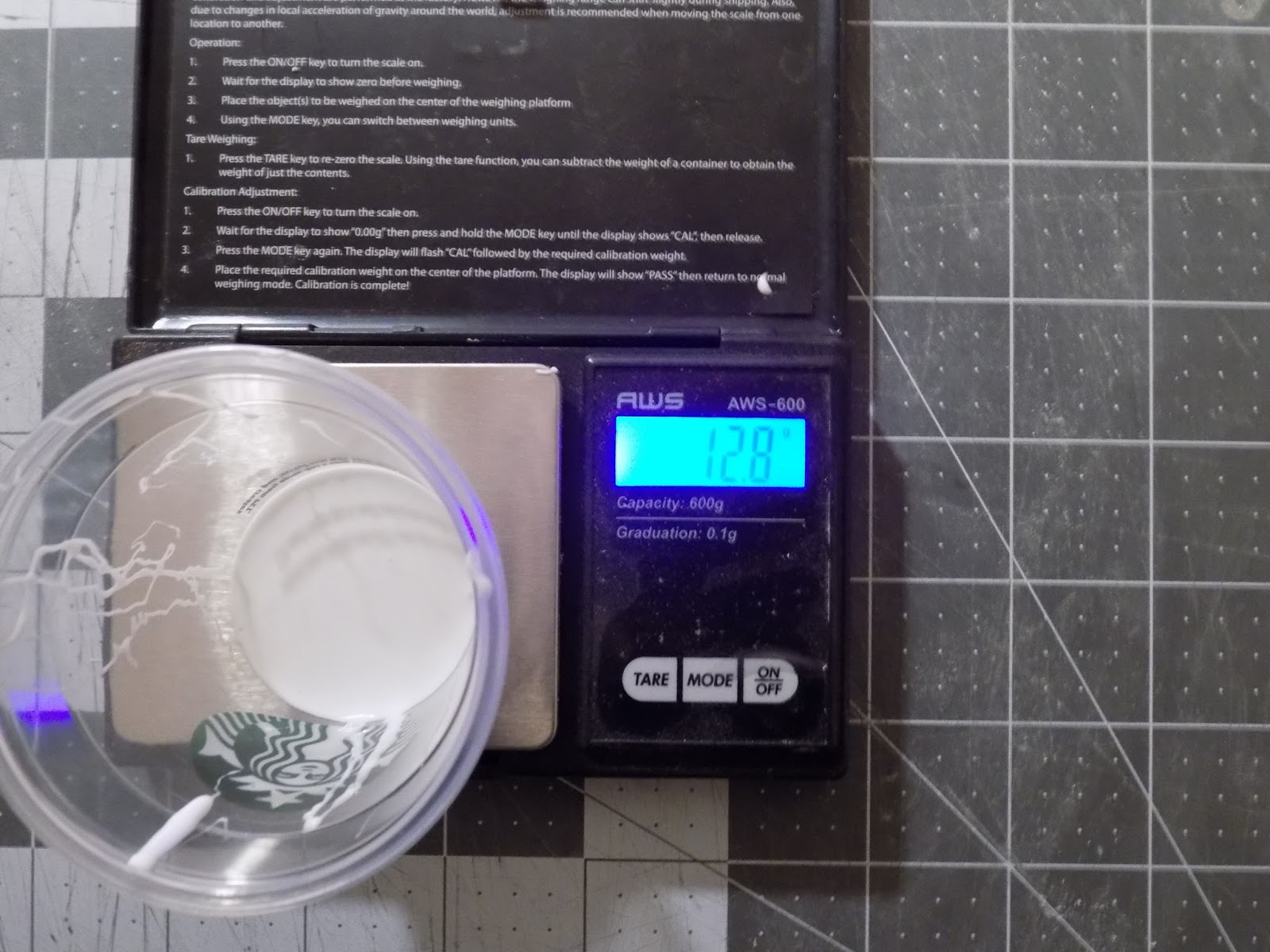
First, I weighed the cup. Exactly 2.8 grams. Once I had the cup base weight measured, I tared the digital scale back to zero, and carefully poured exactly 10 grams of glue into the cup.


With that done, I double checked the combined mass of the glue and the cup - exactly 12.8 grams.


I always have to double check with this scale. It's so accurate, it can easily slip out of calibration and be off by a tenth of a gram. I always check the tare with a 100 gram weight, so I can be sure of my results.

A thin layer of wood glue dries very quickly. But a large mass in a cup like this takes a long time to dry fully - I mean many weeks. To prevent the glue collecting dust, I covered the cup gently with a bit of cotton cloth, stuck the glue on a shelf, and checked it from time to time.


Two months later, I was satisfied that the glue was as dry as it would get, and decided it was time to check the results.

I carefully tared my scale and weighed the cup of glue. The combined weight of cup and glue was exactly 8 grams.


Subtracting the 2.8 grams of the cup's mass, that meant the glue had gone from 10 grams to 5.2 grams. It would seem that in the Titebond II yellow carpenter's glue, the mass was 48% water weight, which would be lost as the project dried.

That's a significant loss in weight. Since glue is generally used sparingly, the weight it adds to your rocket is pretty small (though I admit I thought the final dried glue would weigh even less).

I was all set to write this up here on The Rocket N00b blog, when I realized I really should compare my favorite glue with another commonly-used adhesive, Elmer's Glue All. If I wanted this information to be of interest to more people than just myself, I needed some context.

White Glue

Again, I weighed a sample cup, and again, it came to exactly 2.8 grams (I wanted to make sure in case there were some variance).

I poured in exactly 10 grams of Elmer's Glue-All, weighed the final combined cup, and it was exactly 12.8 grams.


Interestingly, the Elmer's dried much faster than the Titebond II. It only took 2-3 weeks for me to be satisfied the glue was completely dry all the way through.

Once it had dried, the combined cup and white glue weighed exactly 7 grams.


Minus the 2.8 grams of the cup, the glue went from 10 grams to 4.2 grams! So, the Elmer's Glue All is 58% water weight!

For lightweight building, it would seem that, at least between these two choices, the white glue is the winner by a small margin, although either one looks to be pretty darn good. Both white and yellow glue are cheap and nontoxic, they form a nice strong bond between wood and paper (such as balsa fins and body tubes), and any mess can be cleaned up with warm water before the glue dries. Since both are nontoxic and easy to work with, you can control how much you apply - using fingers to wipe off excess - so you can use a small amount, and once the glue dries, it will weigh about half as much as when you put it on.

What About Epoxy?

Sometimes on the forums, a newcomer will upload a small, low-power model rocket build they've been working on, and in an attempt to do a really good job, they reach for epoxy as their main adhesive.

There are some instances where epoxy might be appropriate on a low or mid power rocket build. Attaching a plastic Estes screw-on motor retainer, for example, calls for a small dab of JB Weld steel-reinforced epoxy.


For low power model rocketry, though, use of epoxy should be sparing - if used at all. For most of the main parts of the build - attaching balsa fins and a launch lug to the paper body tube, for example, or installing the motor mount into the rocket - epoxy is overkill.

There's nothing wrong with epoxy. You certainly can use it for small model rockets if you choose. But here are a few reasons you might go with white or yellow glue instead.

First, epoxy is messy. It's a two-part adhesive made up of the epoxy resin itself and a hardener, which you have to mix together. It's toxic, so you shouldn't touch it with your skin. Because of it's toxicity and its thick, honey-like viscosity, it can be hard to get just the right amount onto the part you're trying to glue on (you can use a brush, but the brush will have to be discarded), so you'll probably use more than you need. And, going with the topic of this post, epoxy starts heavy and stays heavy.

Unlike wood glue or white glue, epoxy doesn't dry, it cures. The two parts are mixed together and a chemical reaction occurs in which the molecules in the epoxy and hardener join together to form longer, more complicated molecules, and the substance changes from a liquid to a solid. Because of that, epoxy, which is already pretty heavy, doesn't lose any mass, and you'll end up with a heavier rocket than you may want, without necessarily even benefiting from a better adhesive bond.

I think the reason some beginners reach for the epoxy for their smaller rockets is that they see high power rocketeers use epoxy on the online forums, and perhaps think "this is what the REAL rocketeers use, so it must be better!"

There are good reasons for high power rocketeers to use epoxy. Some high power rockets are made of fiberglass or carbon fiber, neither of which will stick to wood glues. And the forces encountered in high power rocketry can call for heavier duty adhesives, even on paper tubes and plywood fins (though there are times when a good wood glue will work just fine). But while some epoxies are up to the task, others are... well, they're fine for general use, but not necessarily better than wood or white glues. Higher performing epoxies are out there, but they come with a higher price tag. There are many different kinds of epoxies, and it's hard to make a general statement which applies to all of them.

Let's look at what is often a hobbyist's first epoxy, Bob Smith 30 minute. Epoxies have a set cure time, and they may be 5 minutes, 15 minutes, 30 or more - up to hours. Longer cure times generally make for stronger epoxies. The Bob Smith 30 minute is a pretty good one for a low price, and I've used it for a number of mid power builds.


Here, I've measured some out. Getting just about 10 grams was an accident. Because it's hard to work with, and you have to stir it, I was just trying to get some amount in the cup, but here you see I've nearly hit 10 grams, with the cup weighing 12.9g.

A few hours later, well after it had cured, the cup weighed 12.8 grams.


This means one of two things: either the epoxy did lose a small amount of mass during its curing process, or far more likely, I needed to re-tare my scale.

Epoxy certainly will work as an adhesive for low power model rocket building. But because it is toxic, you shouldn't handle epoxy without protective nitrile gloves. When mixing large batches, you may also need to use a respirator, to protect your lungs from toxic fumes. Since it's messy and harder to handle, you are likely to use more than you need, adding extra weight. And since epoxy cures rather than drying, none of that extra weight will be lost before you paint and fly the rocket.

There are some reasons you might want to use epoxy in low power builds, depending on what you're trying to do, and I'll talk about those in an upcoming post. I'll also attempt to test out a few properties of these adhesives, including adhesive strength and brittleness vs. flexibility. I found a few surprises.

Follow me on Twitter.

Like my Facebook page for blog updates and extra stuff.

Have a question you'd like to see addressed on this blog? Email me at iamtherocketn00b@gmail.com.

Thursday, May 3, 2018

Rocket N00b Update


Little N00b was born on April 5, 2018. He and Mrs. N00b are doing great, happy and healthy.

We're home now, and I've managed to secure a little time off work. And though it may sound surprising, as we have a newborn, I am now in the mood to get back to rocketry. Here are some random updates, thoughts, etc. to get me started writing again. It's probably going to ramble a bit, but once I'm done, I hope to get back to more informative posts.

First of all, if you're a longtime reader of the blog (and one of the few who've stuck around during my long dry periods with no new posts), I regret that I haven't updated the blog as often as I used to. I know that this isn't a job and I don't have subscribers or patrons to answer to, but I do feel a sense of responsibility to the blog.

At its peak, I was surprised by how many daily page views I was getting, and I would sometimes hear from rocketry beginners who'd found the blog and gotten some useful information from it. Those page views have diminished, as will happen when a blog, YouTube channel, or podcast stops creating regular content.

Actually, I've felt for some time that this blog has somewhat of an identity crisis.

A model rocket graveyard - Huntsville, AL

What am I trying to do with The Rocket N00b? I've always described it as a "model rocketry blog for beginners," but I don't always stick to that concept. Sometimes I've posted things which will only be relevant to more experienced rocketeers. Then sometimes I try to go back and write something really basic that I feel I skipped over when I was first publishing the blog. When I do that, I sometimes wonder if it's too late - or if what I'm writing is too basic at this point.

When I first started The Rocket N00b, the idea was to share information as I was learning it - so that other Rocket N00bs could learn along with me, as it were. I wanted to clearly spell out things so that anybody could understand them - whether or not they had any background in the science and engineering aspects that touch on model rocketry, or any experience using tools and paint and making things with their hands, or what have you. The idea was that I had discovered this thing which was really really fun, which was kind of science-y, had a crafty aspect to it, and I wanted to explain it to other people who might be looking for this kind of information on the Internet. Not that I expected anybody to ever even find the blog. But it was my attempt to convince the few friends I thought would be the only readers that this is pretty fun, it's just challenging enough to be interesting, but it's not too hard or expensive - and you should join me!

My ideal audience, actually, was my friend Paul.


Paul was a friend I met while acting in and directing plays at the Bloomington Playwrights Project in Bloomington, Indiana. It was through this theater that - oddly enough - I discovered an obsession with rocketry.

Like me, Paul was more of an artsy type than a technical one. He's a smart guy, but his field of work has nothing to do with science or technology, or building or painting things. But he has a young son, and since rocketry is a great hobby to pursue with kids, I figured he might be interested. In fact, he did express some interest. And while Paul and I now live in different parts of the country, he still serves as a good imaginary audience.

I figure if I can explain an aspect of the physics of rocketry in a way Paul would understand it, I'm hitting the right tone. If I can explain an aspect of model building or painting in a way that would make sense to him, then I'm doing what I set out to do.

This is why my blog posts tended to be rather long - I wanted to give the reader all the information I can, clearly and thoroughly, and leave them with no big questions.

But, of course, while I was writing the blog, I was also reading a ton about the various aspects of model rocketry. My knowledge was growing far faster than I could reasonably write about it. And sometimes I'd skip ahead.

Besides, maybe a blog format isn't the best way to organize information for beginners. Blogs may bounce from topic to topic. They're not books, with information neatly organized in chapters, to be consumed chronologically.

Of course, there already are books on model rocketry for beginners. The Handbook of Model Rocketry and Make: Rockets: Down-to-Earth Rocket Science are both great resources.


But no one book can tell you everything. And often beginners turn to the Internet first when trying to get into a new hobby. I guess when I started I was trying to write a comprehensive online beginner's guide to model rocketry, written by a fellow beginner, while in the process of learning everything - rather a large task to take on, and tough to accomplish in blog format if you're learning faster than you can write.

Perhaps what's more called for is an organized website - with organized pages of topics and subtopics - rather than a blog. I do own rocketn00b.com in case I want to do something like that, but I haven't decided what I want to do with that site yet.

The fact is, lately I've questioned what purpose this blog serves. Who is reading it? Who was reading it when I was publishing several times a week and it was getting lots of traffic? What were those readers getting from it, and what else would they like to see from the blog?

Despite the tag I've put at the bottom of every post the last few years, I almost never get any email asking me to cover a specific topic of rocketry. Perhaps that's because I haven't gone far enough in exploring certain topics for people to ask me for more information. Or perhaps it's simply because most people coming here just like reading about rocketry and don't really need more information from me.

The questions I've asked myself, plus the fact that it takes a lot of writing and good photos to illustrate a post and some double checking of my facts if I'm writing something about the physics of rocketry, have all led me to procrastinate on this blog for so long, it's no longer fair to call it "procrastination." For a while, I even considered quitting the blog.

But... well, I don't want to do that. I enjoy sharing my knowledge and passion for rocketry. I've got lots of ideas for topics, some of which I've been stewing on for some time.  And I think a few of them are pretty good.

I just haven't had the time or energy to write them up lately. In fact, I haven't built anything in months. I've barely touched a model rocket since last fall, with the possible exception of to move one of my models from one place to another. I've been in kind of a funk for some time, and haven't felt motivated to do much building.

The winter was long, and I think the weather got me down a little bit. Work had me tired. And, believe it or not, the Hobbico bankruptcy and the uncertainty surrounding it made me feel really depressed - more than it should have, I'm sure.


I decided to keep my thoughts to myself, of course. And a corporate bankruptcy doesn't usually mean the end of a business. Estes itself had been doing well. There were lots of people who wanted it to succeed. There were lots of reasons to think that this would just be a hiccup for Estes.

Then again, nothing lasts forever. Hobbico had taken on a shocking amount of debt, and who knew at the time if anybody with the means would see buying a model rocket company as a good financial investment? I'm no expert in corporate bankruptcy, but it sure didn't look good.

What I'm saying here is that sometimes I have a slightly pessimistic streak, and while there was plenty of reason for hope, I needed more than speculation to lift my spirits. While I tried my best to make myself believe everything would be just fine, I was having a hard time. Because I love this hobby! And if Estes had been shuttered due to its parent company's mismanagement, well... that would be very bad for the hobby.


So, I kept my mouth shut. I didn't want my worry to poison any groundwater. I'm really just another guy building model rockets, but because of my position as a member of The Rocketry Show podcast, I didn't want any doubts I may have had to be taken by anybody as somehow official. I didn't want my own private freak-out to lead to other people freaking out for no good reason.

Then... The Langford family purchased Estes! No longer a subsidiary of a large company who doesn't really care about model rocketry as anything more than a financial investment, the owners and new CEO care deeply about the hobby, and have a personal history with it!

I don't mean to sound glib. I know that some people under Hobbico most likely lost jobs due to what happened, and I feel for those people and hope that things work out for them. But as for Estes, what looked like a disaster may turn out to have been the best possible thing to happen. I cannot wait to see what happens next with Estes!

This good news really got me pumped up and ready to build. Of course, it all happened right before Little N00b was to be born - and then my mother came to visit for two weeks, sleeping in the Rocket Room. So until now, I haven't been able to get cracking on building again.

Now I'm ready, and pumped. I've got stuff I want to write about. I've got some time off work. I've got an empty Rocket Room, all set to be re-arranged for better space usage. I have a build pile which is out of control. And - most importantly - I know my supply of low power black powder motors isn't going to dry up forever.

* * *

So, what's this blog going to be from here on out? I don't know. I do know I want to get back into regular publication. And I want to have some stuff that's useful for n00bs. So you more experienced rocketeers may find some pretty basic stuff on here. I'm sure that's probably fine - most rocket people I know like reading about rocketry, even if they already know the information they're reading. Some things will be for absolute beginners, and some things won't.

Coming up in the near future - some stuff about different glues, some stuff about balsa wood grain filling techniques, and some stuff about protecting your parachute. Also, I've got some builds I'll be posting, because I know rocketeers enjoy seeing those, and I've got a couple I'm proud of.

OK, end of rambling. Back to rocketry.


Follow me on Twitter.

Like my Facebook page for blog updates and extra stuff.

Have a question you'd like to see addressed on this blog? Email me at iamtherocketn00b@gmail.com.

Thursday, March 22, 2018

Fragile Payload


This is one reason I haven't posted lately. Little N00b arrives in two weeks.

This is one of several 3D ultrasound images. Amazing. I was amazed to see recognizable features this early - this was nearly two months ago, and he already looks like one of the family in this photo.

Follow me on Twitter.

Like my Facebook page for blog updates and extra stuff.

Have a question you'd like to see addressed on this blog? Email me at iamtherocketn00b@gmail.com.

Monday, January 15, 2018

Estes Posts More "Coming Soon"


The above was posted on Estes' Facebook page today.


Some folks got a little concerned when the Estes website seemed to be down a few hours ago, but it appears to have been only a hiccup which would have gone unnoticed if we weren't all a bit on edge recently.

I want to refrain from too much public speculation about what the Hobbico bankruptcy might or might not mean for the future of Estes. But I will take the continuing announcement of new rockets as a positive sign and continue to hope for the best.

Follow me on Twitter.

Like my Facebook page for blog updates and extra stuff.

Have a question you'd like to see addressed on this blog? Email me at iamtherocketn00b@gmail.com.

Wednesday, January 10, 2018

Hobbico Bankruptcy


Hobbico, the Champaign, IL company which owns Estes Industries (along with a large number of hobby outfitters), is filing for Chapter 11 bankruptcy, and layoffs may begin in April, according to an article on the Champaign News-Gazette website.

I do not know what this means for the future of Estes (though I have read a lot of speculation online), but I am quite concerned. One line in the article in particular has me worried:
Hobbico “has determined that it may be necessary in the near future to permanently close and discontinue all of its operations in connection with a bankruptcy case to be filed under chapter 11 of the United States Bankruptcy Code,” wrote human resources Director Howard Salazar in a letter dated Wednesday obtained by The News-Gazette.
Chapter 11 bankruptcy does not necessarily mean going out of business, but it may mean that Hobbico will have to sell off what it can. And though those of us in this hobby love Estes, in today's climate where this is rather an underground hobby, who will buy a model rocket company? 

Somebody, I hope! This is not the first time Estes has been up for auction. But nothing is guaranteed in this world. There are other model rocket companies, but as of right now there are no other low power model rocket motor manufacturers, and that's key.

Estes isn't really in the model rocket kit business - it's in the model rocket motor business. The kits are what they make so we'll have something to burn motors in. That's how they make money, and it's why we need them.


There are other model rocket kit companies, and you can always design your own and build from scratch. And, of course, there are AeroTech and Cesaroni composite motors - most of them mid and high power, but a few smaller ones. Once AeroTech/Quest come out with their line of Q-Jet composite motors, you'll have something low power to fly your standard 18mm model rocket kits on.

But without small, easy-to-use black powder model rocket motors, I worry for the future of this hobby. BP motors are cheap, and simple enough for kids to use without too much fiddling. And you've got to keep getting kids into this hobby if you want it to remain strong and not die out.

I'm usually pretty skeptical when I see people in online forums claiming the sky is falling after seeing a news article about something negative happening in model rocketry. Whenever there's an incident or accident, someone always claims that this is the end, folks. And it never has been so far.

But guys, I just got into this thing a few years ago, and it means so much to me! So this is one news story which actually has me rather worried.

So, let's all hope for the best, and maybe pool our money...

Now, if you'll excuse me, I need to go check my PowerBall ticket, to see if I can afford to buy a model rocket company.

Follow me on Twitter.

Like my Facebook page for blog updates and extra stuff.

Have a question you'd like to see addressed on this blog? Email me at iamtherocketn00b@gmail.com.

Thursday, January 4, 2018

2017 Rocket Launch Slo Mo Supercut


Some footage by Joe Barnard.

Follow me on Twitter.

Like my Facebook page for blog updates and extra stuff.

Have a question you'd like to see addressed on this blog? Email me at iamtherocketn00b@gmail.com.