Showing posts with label Q2G2. Show all posts

Sunday, October 9, 2016

Rocketober 9 - "Rocket Wish List" and More Sky Wolf Building

All this month I'm posting photos on Twitter for #Rocketober. They'll appear here with slightly expanded text.


I've been battling a cold the past few days, so I haven't done much building or Rocketober tweeting. I had some time today, though, so here's what I've done so far.

The Apogee Components theme of the day is "Rocket Wish List." I have a lot of things on my wish list, but the biggest one is for Quest motors and Q2G2 igniters to come back.

Back to Sky Wolf...


Once the electrical tape was removed, the shock chord was securely epoxied to the motor tube. A bit of sanding was required, as some epoxy oozed down the sides of the motor tube under the tape edges, and you need a clear space to attach the fins to the motor tube.


The knot in the shock chord stuck up a little bit above the forward centering ring and hardened. While I could still get the motor mount into the airframe, the pressure would cause the airframe to distort. I sanded the knot down level with the centering rings. Since the knot isn't tied to anything, and is only used as a shock chord stop, this will be fine.


 The fins came wrapped in masking tape, which left sticky residue on the fins. This would need to be removed.


I decided to try my standby for removing sticky adhesive goo, Ronsonol lighter fluid. Goo Gone would work, but it would soak into the fins and leave a greasy residue, possibly ruining them. The lighter fluid would evaporate, making it a better choice. 


Just a small bit of lighter fluid on a swab takes care of the tape residue.


The fins are now all clean, and can be sanded.


First, I need to check the accuracy of the shape of the fins from my simulation. I printed out the fin templates on paper and laid the actual fins on them. The aft fin is just about perfect. The forward fin is pretty close - close enough for a simulation. The difference in center of pressure between my simulation and a "correct" one will probably be less than a millimeter.


This tool is called a sewing gauge. It's used for marking hems and button hole locations on clothing. I use it to mark guide line positions on fins when I sand airfoils or beveled edges. It costs around a dollar and can be found at fabric stores or craft stores, or anywhere that sells any kind of sewing supplies.


The leading edges of the forward fins will have a short bevel and rounded edge. I set the sewing gauge for 1/4 inch and make two or three marks about 1/4 inch back from each leading edge. I do all leading edges first, then adjust the gauge, and do all trailing edges.


The trailing edges of the fins will have a longer bevel - about 3/4 inch - down to a much sharper edge.


Once all the marks have been made, connect them with a ruler.


Now I have clear guide lines for sanding my beveled edges. I'll sand to the pencil lines, then stop.


I use my ruler to mark a center line down the edges of the fins. I make a mark, then flip the fin over and make another mark. Now I have a double line which gives me an indication of how close to the true center of the fin edge I'm sanding.


I've rounded the leading edge of one fin. By sandwiching the fins together, I can check the sides and make sure I'm sanding evenly. Then I'll do some touch-ups if necessary. See my pencil lines?


Once all three fins have been rounded over, I sandwich them together again and compare them. You should continually check your work as you sand so you can make things more even if necessary.


Look at the fins edge-on as well, to make sure things are staying straight.


When beveling trailing edges, again, stack the fins together to compare them. Make sure you're sanding evenly.


This one will need a little touch-up, as it's slightly uneven. And when I'm done with all three trailing edges, I'll gently go over all fins to take off the sharp transition between the flat part and beveled part.


When I install the motor mount, the shock chord must not be in line with any of the fin slots, because the fins will be attached to the motor tube. The shock chord must go between fin slots, and to keep things neat, I'll like it up with the launch lug line, as shown.


To make sure I don't get confused when gluing in the motor mount, I've made a pencil mark in line with where the shock chord is mounted. I'll line that up with the launch lug line, and everything should fit together just fine.

Follow me on Twitter.

Like my Facebook page for blog updates and extra stuff.

Have a question you'd like to see addressed on this blog? Email me at iamtherocketn00b@gmail.com.

Monday, August 22, 2016

The Current State of Quest Q2G2 Igniters


Yesterday on The Rocketry Forum, on the subject of the Quest Q2G2 model rocket igniter, someone asked "Why is it so hard to get these things now... is this an Aerotech thing or what ??"

The Q2G2, seen above in its current form (they used to be blue), are a popular igniter for model rocketry, and have some high power uses as well. They are particularly useful to rocketeers who like to launch clusters - rockets with two or more motors firing in parallel.

[Edit: according to one of the commenters, Q2G2 always came in blue and red. I have seen pictures of blue ones, but only ever had red ones. Quest in recent years changed how they are made, to conform to new AFTE regulations. While still great, they are slightly slower to fire than they used to be. I had assumed there was a change in color to signify the different formula. Apparently, I was mistaken about this.]

Preparing a 3-motor cluster with Quest Q2G2 igniters

Because they are low-current igniters, and because they have a pyrogen tip, they are very reliable for igniting multiple motors quickly and simultaneously - very important in clusters. You need all motors to ignite at the same time or the rocket may leave the launch pad with unfired motors, which will result in an underpowered flight, or a flight which may veer off in one direction. The Q2G2 is a much better igniter for clusters than the Estes igniter, especially now that the Estes igniters no longer have a black pyrogen tip.

High power rocketeers sometimes like to use the Q2G2 to ignite electronically-controlled ejection charges, in a process known as dual deployment. Rather than using a motor with an ejection charge, which is the standard for model rocketry, in dual deployment, the motor has no ejection charge. Instead, the charges are installed in the rocket by the flyer, and are controlled by an altimeter on board. At apogee, the altimeter sends an electric current to fire an igniter or e-match, which sets off the first charge. This usually deploys a small drogue parachute. It stabilizes the rocket's descent, but doesn't slow it down too much.

Then, at a lower altitude, the altimeter causes a second charge to fire, deploying a larger, main parachute. The purpose of this is to keep the rocket from drifting too far to recover it, especially if it's going to fly to a very high altitude. The Q2G2 makes an excellent and reliable substitute for an e-match, which is why it's popular for dual deployment.

The Q2G2 comes bundled with Quest motors, or can be purchased alone.


But for the last couple of years, Quest igniters and Quest motors have been hard to come by. For a while, rumors circulated that perhaps they were going away.

One advantage of being on The Rocketry Show podcast is that I've made contacts with some interesting people who can answer questions. A while back, we interviewed Charles Savoie of AeroTech, manufacturer of mid power kits and mid and high power composite rocket motors. AeroTech now owns Quest Aerospace. He assured us that, no, the Q2G2 and Quest motors would not disappear. In fact, to make things easier and more readily available, manufacture would be relocated to the United States from China.

But since the question popped up on TRF, and since I've been looking for both Quest motors and igniters for myself for a while, I sent him an email to ask if he could shed some light on the situation.

He replied, "The Q2G2's are still being resolved as we deal with some supply chain issues with China. They had a huge explosion last year that has seemed to have an affect on hazardous materials and how they ship and store them. We are working on a solution now but nothing for sure."

"Are you still planning on moving manufacture of the Quest stuff to the US?" I asked.

"Yes," he replied, "we currently have the new Quest motors in the certification process. Once we get the design settled we will begin production."

This is good news. Although the Q2G2 igniters seem to be in limbo at the moment, with new motors will come new igniters. This kind of transition takes a lot of logistics and planning, so the issue may not be resolved right away. But our patience may be rewarded with wider motor selection for low power rockets, and more readily available igniters for those cluster rockets some of us love.

Part 1 of the Charles Savoie interview on The Rocketry Show can be heard here.

Part 2 is here

Like my Facebook page for blog updates and extra stuff.

Follow me on Twitter.

Tuesday, January 5, 2016

A Chat with Aerotech, Part 1

Season 2, Episode 7 of The Rocketry Show is up now, featuring our conversation with Charles Savoie, General Manager of Aerotech.

This conversation was really great, and it was long enough - and informative enough - to make it a two-part show.

We discuss Aerotech history a bit, plus some news of things upcoming. And since Aerotech and Quest Aerospace merged not long ago, we also have some Quest news - and it all seems pretty good!

People have been concerned about the supply of goods from Quest - particularly motors and the indispensable Q2G2 igniter. We talked with Charlie about that, and it should answer some questions.

I'm writing this before listening to Part 1, so I'm not sure what part of our interview is in there, but it's a great show, and I think you'll like what you hear. Part 2 will arrive soon!

Like my Facebook page for blog updates and extra features.

Friday, September 18, 2015

Igniter Tip - Q2G2's Keep Falling Out?

Edit:

If you look at the comment section below, you'll see a few rocketeers have corrected my big dumb mistake here. Turns out, I was mis-reading the instructions for the Q2G2 igniter, and inserting it all wrong in the first place.

My initial reaction was to delete this post. But I've decided to leave it up for two reasons.

1 - It's a good example of a n00b mistake - not reading the directions.

2 - It's full of pretty pictures.

For the correct method of installing Q2G2 igniters, see this post by Chris Michielssen.

My apologies for not doing my homework!

. . . 

In May, I went to launch some rockets with Chad. I took along several I'd built but never flown before. It was breezy, and I lost a few. Against my better judgment, I put the Quest Quadrunner on the launch pad.


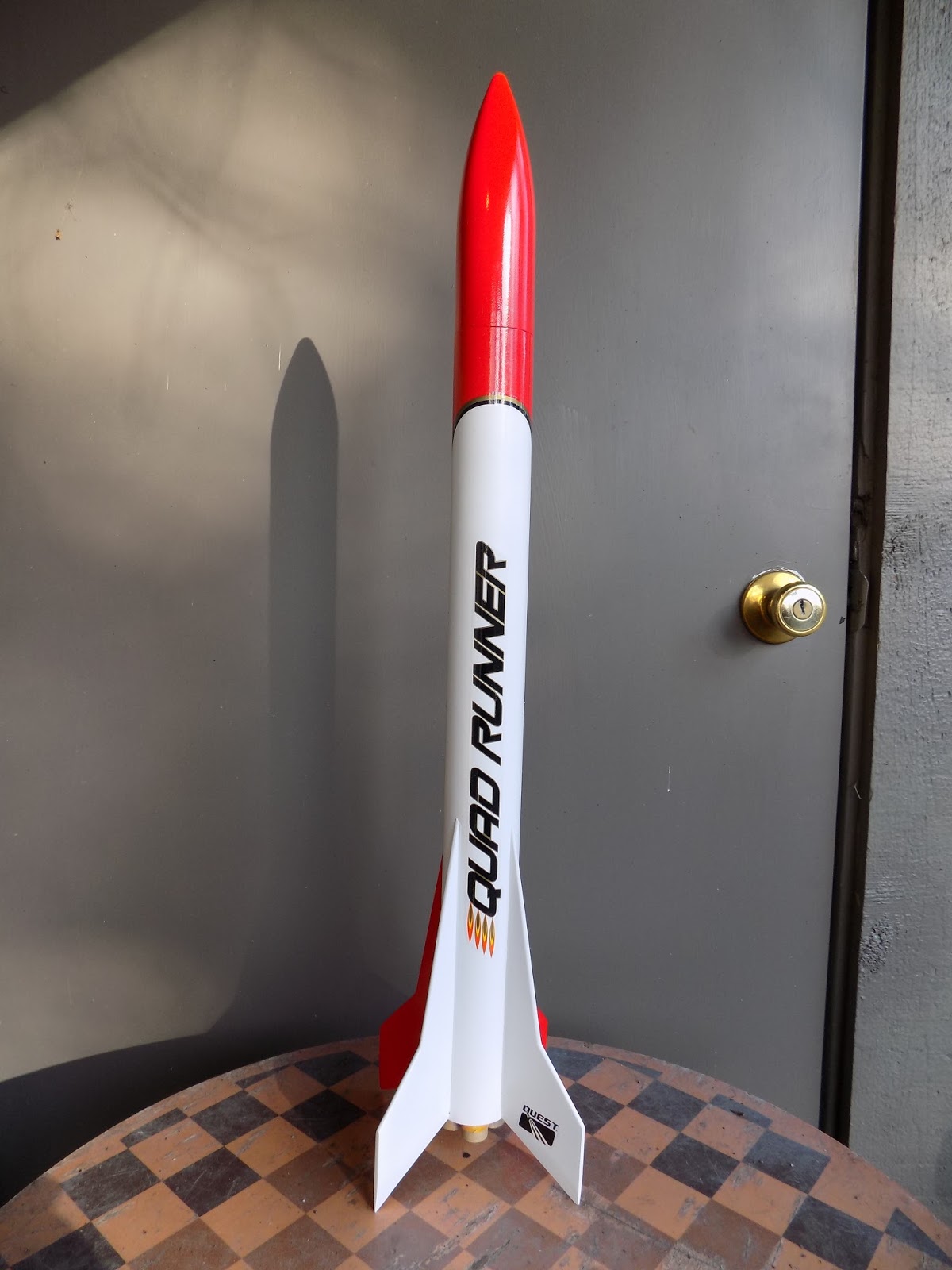
This beauty of a rocket from Quest Aerospace is a four-motor cluster capable of pretty high altitudes for a model rocket. It took me a long time and some heartache to build, but in the end it turned out really beautiful.

I installed four standard EC6-7 motors in the rocket. But clusters are tricky. The trick is getting all the motors to ignite at once. Estes motors (or "engines") all come with igniters, but they're not as reliable as you want for a cluster rocket.


There are a couple problems that prevent Estes igniters from being ideal for clusters. One is their size - they're pretty small and don't have much reach. But the main problem is that they require too much current.

Getting one Estes igniter to fire is one thing, but when you have the current from your launch controller split between two or more igniters, the total current reaching each igniter tip is less and less. What can then happen is that sometimes one motor might fire, and take the rocket with it, ripping out the other igniters before the other motors light.

Quest Aerospace has a much better igniter for this job. It's called the Q2G2 igniter.


These were off the market for a while, but they're back. The supply still can't quite meet the demand, but they are on the market.

Two things make this igniter much better for cluster rockets.

The first, is that the igniter has a black pyrogen on the tip.


This is a flammable substance. When the igniter tip heats up, the pyrogen creates a small flash or flame, aiding in the motor's ignition.

Estes igniters used to have a pyrogen, but they stopped making them like that in the last year. I still have a few, but I save them for special occasions.

But what makes the Q2G2 an even better igniter for cluster ignition is that they are low current igniters. That means it takes much less electric current to make the tips hot enough to ignite the rocket motors. You can send the same amount of current through several Q2G2 igniters as through one Estes igniter, and they will all fire pretty much simultaneously.

I put the Quadrunner on the pad, inserted the safety key into my launch controller, counted nervously down from 5, pressed the ignition button... And there was this loud puffing sound signifying ignition.

And then the rocket just sat there. Fortunately! I'm sure I would have lost it otherwise!

But what had happened?

As you can see in the above photos, the Q2G2 comes packed in a little red straw. This is actually what keeps the igniter installed in the motor before ignition. This is a different method than the plastic plug method seen in the Estes igniter photos.

Quest Q2G2 installed in an Estes C6-7 motor

I really like the straw method. It allows you to insert the igniter until you can really feel that it's in contact with the propellant.

I looked at the rocket. The Q2G2 igniters - all of them - had slipped downward a little inside their straws. The straws were blackened, and the puff of the pyrogen had actually ejected them from the nozzles of the rocket motors without igniting any of the propellant.

OK, so that saved me losing a beautiful rocket on its first flight.

On other occasions, I've used multiple Q2G2 igniters successfully, but only after fiddling around with them, then placing the rocket gingerly on the pad, hoping nothing would disturb the igniters before I pressed the launch button. Then I'd have to rush to launch the rocket before any of them fell out.

Rushing is not a good idea with rockets.

I've got a big launch coming up in a large field, and I'd love to see the Quadrunner finally take flight, and have a reliable ignition system securely in place.

If you've had trouble keeping your Q2G2 igniters staying in place, here's a way to prevent them falling out.

The problem isn't the straw. It fits into the nozzle of the rocket motor just fine. The problem is that the igniter itself can pass too easily through the straw, slipping out before you press the launch button.

Here's what you do:

Cut a very small bit of masking tape.


Wrap the masking tape around the twisted part of the Q2G2 igniter. You don't want to cover the pyrogen head, obviously, and you want to leave the free ends of the igniter free to bend them in whatever direction you need to to hook the leads up to the launch controller.


You want just enough masking tape around the twisted part of the igniter so that it can still pass all the way through the straw and come into contact with the propellant, but that it will have enough of a friction fit that it won't fall out.


Now the igniter is securely installed. Don't worry - it isn't "stuck." When the motor ignites, it will eject the straw and the igniter. But it will ensure you get reliable ignition on as many motors you have in your cluster rocket!

Note: These pictures are for illustration only. You should not install the igniters in your rocket motors until you are on the flying field, preparing for launch!

Edit: As Rich Holmes correctly points out, it's fine to install an igniter at home. It won't fire unless the launch controller is hooked up to it. What I should have said is that you should install the motor in the rocket first, then install the igniter.

Myself, I wait to install igniters until I'm at the pad. I transport my rockets in a big box full of newspaper, and I figure some of the igniters will fall out if I install them at home.

Like my Facebook page for blog updates.

Friday, February 6, 2015

Rocket Fever

So, I'm under the weather. Thought it might be flu, but perhaps just a bad cold or something. In any case, I've spent hours in bed since Wednesday, when I woke up with a fever, chills and aches.. I thought I wouldn't be able to get any rocket building done in this condition. I don't like to build when I'm excessively tired - it makes me sloppy.

But I had time on my hands, so I chipped away at a couple of projects.

The Trident A cluster rocket is nearly done.

The Trident A has a cluster of three motors, with exposed motor tubes, for awesomeness.


This was the very first rocket I designed, a few months ago. Building it was much easier than I'd thought it would be, and I'm sorry to say that I really didn't take any pictures of the process. I thought this would be a rocket I could easily mess up, but it hasn't been bad at all.

Masking and painting, thought... That might be tough. This might call for an airbrush. Here's the color scheme I'm thinking of:

The airframe is white, the motor tubes inside that are red, and the fins - with tabs - are black. I'm not
sure how I'm going to get these colors where they need to be and nowhere else!
I wanted to start building yet another Cosmic Explorer with an E motor mount after losing my previous one, but I realized I didn't have enough centering rings. I'd buy them from JonRocket.com, but in order to justify the shipping, I like to buy a bunch of stuff at once.

I also received some Quest Q2G2 initiators in the mail!


For n00bs, let me explain the significance of these.

Q2G2's are igniters for black powder motors, just like the ones that come with your Estes motors. But they're made differently. For one thing, they're insulated, so they won't short out at the launch pad. More importantly, they are low-current igniters, which means they take less electric current to get them to fire. In fact, an Estes launch controller can't be used with them, because they'd fire as soon as you put in the safety key. Why would you want that?

Because the Q2G2 requires less current to fire, they light up almost instantaneously, which is very important when launching a cluster rocket - you want all the motors to ignite simultaneously, or the rocket will take off with only some of its motors firing.

But most significant of all is that these have been off the market for months! Possibly since I first got into rocketry, possibly longer.

All I know is that I seemed to have just missed the boat on these, and just when I really started getting excited by the idea of cluster rockets. To date, I've only done one cluster launch - my Quest Magnum Sport Loader, launched with Estes igniters. That was fine - it's only a two-motor rocket. But reliable ignition is the biggest issue with clusters, and the more motors you have, the more igniters, the trickier it gets. I'm so glad I have these!

BTW: I got these from BuyRocketMotors.com, a site to bookmark. They specialize in high power motors, so if you're new, you won't need them for a little while. But you'd be surprised how quickly people go from Skill Level 1 Estes kits to high power rocketry.

I accessed it by going first to brm.therocketryshow.com. The Rocketry Show is a podcast you should check out - whether you're a beginner or not - run by a couple of guys from Ohio. It's still pretty new, but promises to cover a lot of aspects of hobby rocketry - from low power model rockets to high power. If, like me, you're both a podcast junkie and obsessed with rockets, it's the perfect combo.


Anyway, if you get your motors through brm.therocketryshow.com, part of your purchase will help support The Rocketry Show.

I also got some more rockets in the mail today. I know - I have way too many. But my parents had given me a $50 gift card to Estes for my birthday. I'd just bought a ton of Estes rockets. I really wasn't sure what I'd use it on.


Then, Estes had a repeat of its holiday sale. Since I'd lost the Cosmic Explorer, I got another one of those (I need backups, guys!), plus a long two-stage rocket called the Air Commander. I'd turned my nose up at that one during the holidays, for whatever reason. I decided this time to just get it.

I had to spend $49.99 for free shipping. I nearly bought the 4-rocket PSII bundle again, just so I'd have plenty of them to potentially screw up building or lose in flight, but I went a different route. I got one that was not on sale - really, I wanted the free shipping. I ended up getting something I'd had my eye on for a while - the Nike Smoke, a 1:5.5 scale model of a NASA sounding rocket.


It's a nice-sized rocket with a nose cone that's nearly the length of the airframe.

I also picked up a replacement parachute for Der Red Max. That chute has taken quite a beating.

Since the Nike Smoke has plastic fins which are pre-beveled, it should take me a lot less time to build. I cannot stop myself from shaping the fins at least a little to improve aerodynamics, and I can't keep myself from filling the wood grain on wooden fins. This makes my builds take more time than they might.

I was about set to start building the Nike Smoke right away, when I noticed that one of the plastic fins was deformed.

The lower corner of this fin is round. It's supposed to be pointed. This is a molding error.
I emailed Estes to find out what to do about this, but it was late on a Friday. So I assume I won't hear anything until Monday. Bummer. I'd like to start this rocket. But I guess I'll have to wait.

Well, hopefully I'll feel better soon. My fever seems to be gone. And I've got to go back to work. Plus I'm directing a show at the Bloomington Playwrights Project, so that's going to take up some time and energy.

Tuesday, November 25, 2014

Bill Stine Himself on Quest Igniters

I think something incredible just happened.

If you're new to rockets, this might not mean anything to you, but stick with me. I'll explain.

So, Estes is not the only rocket company in the rocket biz. There are lots. One of them, Quest Aerospace (perhaps Estes' biggest rival in the low power rocket arena) is another. I have a few of their rockets, including the Magnum Sport Loader, a two-motor cluster rocket. Here's the video:


Quest has a line of motors and igniters. The igniters are called Q2G2, and they're sought after because they're very reliable - especially if you do cluster launches of low power, black powder motors (that's all I'm up to at this point). They require very low amperage to get them to fire, which means it takes less juice to get them to work quickly and properly - very important, since you want all your motors to ignite at the same time in a cluster rocket.

Problem is, Quest motors and starters have been out of stock for months - since long before I got involved in clusters. I kept hearing they'd be back in stock "in November," but, they're just not. Apogee Components has lately been saying "July 15."

I posted a thread on The Rocketry Forum to ask what the deal was. Were they ever coming back? Some insisted that, no, they are gone for good. Something to do with a recent merger between Quest and AeroTech (a company that specializes more in mid and high power rockets and motors). This Quest Q2G2 issue has been a hot topic in rocketry circles lately, and the thread has generated a lot of replies.

OK, that's Part One.

There's a guy named Bill Stine. He's basically been around hobby rocketry since the beginning, and he's the author - along with his father, the late G. Harry Stine (one of the founding members of model rocketry) - of The Handbook of Model Rocketry. If you're serious about pursuing rocketry as a hobby, and want to understand more about it, this book is required reading. I bought a copy for my Kindle and devoured it a few months back, and I turn back to it frequently. Seriously, get this book - it has a lot of information important to understanding rocketry basics. Point is, Bill Stine is one of the biggest names in hobby rocketry. He's like the Richard Leakey of model rockets.


Well, it appears as though Bill Stine himself responded to my thread.

Here's what he had to say:


Originally Posted by OldRocketeer"II"

OK, here's an official response from Quest:

First, NO, Q2G2 igniters are NOT gone forever and you will be able to purchase them again soon (both shorts and longs). The version that comes packed with the motors will not have any difference at all from the "originals" you guys love! But due to new pending BATF regulations, the ones sold as accessories are going to have a slightly different pyrogen on them - but you likely won't notice any difference.

And yes, we have been out of stock on A's, and then B's and then C6-5's. New production was completed in September and was expected to arrive via ocean freight then. Some regulations on shipping HazMat materials have recently changed in China - and we had to test new shipping cartons. Unexpected after unexpected delays just keep happening, and therefore I won't announce a "solid" arrival date now. but it will be soon...

We appreciate your patience and loyalty.

As to quality, the Quest China motors are very bit as reliable and safe as Estes BP motors (NAR MESS reports certainly support this). They are not made in a fireworks factory and the AQL process and testing is every bit as tough as it was in our own US factory years ago. In fact they are made from military grade BP - it just has a slightly slower burn rate than the US BP does. Most folks love our slightly slower burns, especially the C's. Teachers especially like the slower burn times because the kids get a bigger thrill out of slower boost that they can see...

The merger with AeroTech has been great, but of course there have been some "bumps". Running out of motors certainly was the biggest one...

We hope to have some new product announcements soon that I think the rocketry community will get a big buzz out of.

Bill Stine
Wow, I thought, Bill Stine saw my TRF thread? He REPLIED to my thread? THE Bill Stine?? For real?? Am I reading this right???

I went to his profile page. Looks like he's been on TRF for almost six years, and though I may simply not be understanding what I'm seeing on the website... it looks like my post on TRF is the only one he's ever responded to.

And if that's actually true... it kind of blows my mind.

Anyway, whether or not Bill Stine wrote this post himself, or it's someone quoting Bill, it's good to know Quest will eventually put out new starters, because I want to build bigger clusters, and I want them to launch correctly.

And I choose to believe Bill Stine thought my post worthy of comment. Because... wow...